Thursday, May 21, 2015

Grand Theatre, Starkey-McCully Block, Preservation Awards at Historic Landmarks Commission

Tonight the 21st the Historic Landmarks Commission meets, and mostly it's full of very nice things.

Proposed sign over the High Street entry
You may recall the matters of the Grand Theatre renovation and the Starkey-McCully block renovation.

The staff reports are out, they recommend approval, and truly it looks like there's nothing further to say further about these terrific developments downtown. (Grand here, Starkey-McCully here.)

So that's great to see.

Between renovations at the Salem Arts Building, the McGilchrist & Roth buildings, the Grey building with Amadeus, and now these two - we should pause a moment to appreciate the clustering and passion at this moment in time. There's some fabulous restoration and renovation work going on in downtown right now. Hopefully that can continue, and other buildings and storefronts in turn get the TLC they deserve. Our stock of downtown buildings is a wonderful resource and with adjustments to streets and sidewalks, our downtown can become the vibrant and more prosperous center we all want it to be.

Looking south on Commercial at Court, May 1913
Jaywalking hadn't been invented yet!
Annual Historic Preservation awards are also on the agenda.

Wednesday, May 20, 2015

State Street Connections Could be Next with Minto Bridge Groundbreaking

Almost certainly you will have heard about the groundbreaking ceremony for the Minto Bridge.

(If not, it's at 3pm in the amphitheater at Riverfront Park on Thursday the 21st.)

The fencing has been up and actual digging already well underway, so strictly speaking this is an after-the-fact ceremony and not actual first spade of dirt.

But it's still nice.

So the next piece of the puzzle will be to create better walking and biking connections along State Street and crossing the busy urban highways of Front, Commercial, and Liberty.

The Downtown Strategic Action Plan
recognizes the importance of the natural
connection down State Street (in purple)
Fortunately the State Street entry to Riverfront Park is going to stay open, but after construction for the bridge is complete, the new "park parcel" looks sure to become at least in part an extension of the parking lot. That will mean more cars.

But families will want also to be able to walk and bike from close-in neighborhoods like Bush, Englewood, Grant, and Highland, through downtown, and into Minto Park.

Tuesday, May 19, 2015

Planning Commission to Consider Proposed School and Zoning Change

Zoning is on the agenda at the Planning Commission tonight, the 19th, and it's a fine example of our "exclusionary zoning" scheme.

Market and Commercial site, via streetview
The school district wants to consolidate some programming into a centrally located building. The proposed site's zoning, however, doesn't allow for "Basic Education" in a "Commercial Office Zone." That's an excluded use.

The site in question has been vacant for a bit and is on the southwest corner of Market and Commercial Streets NE. Nearby businesses include Truitt Bros. Cannery buildings and the Chamber of Commerce.


The School District proposes to consolidate Community Transition Programs, which serve "adult students with disabilities who have completed high school with a Modified or Extended Diploma or Certificate of Attainment," but who need additional skills or training; as well as the Literacy Center that is part of the Barbara Roberts High School.

The District says
[S]tudents [in the CTP program] arrive and leave school by school bus or on rare occasions are transported by a family member...students in [the] Roberts High School programs currently arrive at and leave the school by a variety of means. 40-50 are driven in private vehicles, and about 40-50 take public transit. Fewer than 10 students drive themselves, and a similar number use a bicycle.
Some additionally walk, but as the site locations are changed, they may not be able to walk and will use other means.

While the building site is centrally located, "centrally" in this context may have more meaning for cars than for non-auto travel. The immediate north-south streets, Front, Commercial, and Liberty aren't really very congenial for travel on bike or on foot: Front lacks sidewalks and bike lanes and has the treacherous railroad tracks; Commercial and Liberty are a one-way couplet, essentially an urban highway, and though they have bike lanes and sidewalks, they aren't very friendly, and are not rich with east-west crossings.

Especially for Grant and Highland neighbors, connectivity isn't awful, but for those who must come farther, perhaps a site nearer the transit mall would be even better.

But that's not really that important of a detail, especially since the numbers of students aren't that great, and presumably the District has other good reasons to consolidate program locations. (There are lots of other factors in play here.)

The interesting part here is the rigamarole the District has to go through because of our zoning system.

Seriously, why wouldn't you allow an alternative school to use a commercial office building that has languished for a while? Is there any serious case to be made against this?

(The Staff Recommendation is for approval and to advance the ordinance change to a first reading at full Council.)

This situation is an excellent argument on the surface for so-called "form-based codes," which specify building type and form rather than use of a building. They focus on what the thing looks like rather than what you can or cannot do inside of it.

In this case, a low-rise office/warehouse building - a box - that has been vacant for a while seems like a reasonable thing for an alternative school. They won't pollute, they won't create industrial noises, they won't hold parties at midnight. Seems like a very low-intensity use.

And making the School District apply for a regulatory change seems like a dumb level of red tape and city ordinance.

Part of our problem with creating walkable and bikable neighborhoods and commercial districts is our "sort and separate" exlusionary zoning, which tends to inhibit useful adjacencies and creative reuse of existing buildings.

The Planning Commission meets tonight, Tuesday the 19th, 5:30 PM – 7:30 PM at City Hall in Council Chambers.

(There is also the extension of the "Unified Development Code" clean-up project, which identified 52 additional issues that were not "policy neutral" and need further debate and possible change. These have been dormant for a bit, and I guess we will see something from staff perhaps later this year.)

Friday, May 15, 2015

Two Bike Rides Sunday! Research Focus or Family-Friendly

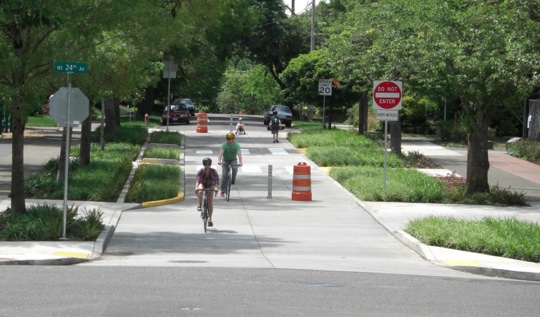
You probably already know about the field trip to Portland for research on bike boulevards, but if you're in town on Sunday, there's another option!

Location of Portland Bike Boulevards:
Concord, Holman, Going, Klickitat
via Metro Bike There map
The Keizer Iris Festival is offering a short bike ride to Spong's Landing Park at 1pm on Sunday the 17th.
The course is flat on a low-traffic route. The ride starts and ends at the parking lot at Cummings Elementary School on Cummings Lane in Keizer. Coordinator: Hersch Sangster 503-390-8024
Spong's Landing is an historic ferry site, dueling with Lincoln across the river! So there's also the legacy of 19th century river transportation, something we don't much think about today.

Bike Boulevard Field Trip

Car-free section of NE Klickitat in Portland
Photo: Scott Batson/PBOT - via BikePortland
If you're feeling more adventurous, don't forget about the trip to visit Portland's network of bike boulevards.

Woodlawn neighborhood, 1894 Portland Paving Map
(The yellow indicates graded, but not yet graveled, sections;
everthing else is dirt/mud. Note also the streetcar line!)
The trip is also on the afternoon of Sunday, May 17th. The trip assembles at Upcycles on 909 NE Dekum St., in the Woodlawn neighborhood, at 1:30pm.
We'll tour the Concord, Holman, Going, and Klickitat Neighborhood Greenways with a Traffic Safety Specialist who can tell us about the design elements used in the creation of bike boulevards.
Woodlawn and Upcycles location today
City of Portland neighborhood greenway map

Wednesday, May 13, 2015

Northwest Hub Moves into Old Safeway on Broadway and Market

The news has been embargoed for a bit now, but they're finally going public!

New Home of NW Hub
An old Safeway at 1230 N Broadway
Salem's home for recycling bicycles, Northwest Hub, has moved from the Evergreen Church site on D Street to the old Safeway on Broadway and Market.

This will give them a lot more warehouse and work space as well as possibilities for a retail storefront!


For more on the history of Safeways in Salem, see here.

Tuesday, May 12, 2015

Rough Roads for the Robots, Amtrak Train Day - Newsbits

Not quite there yet
In some media or another you probably saw the news that the self-driving cars are not yet able to avoid 100% of crashes.

Things are still early, of course, but the lack of reporting and candor about the failures, however small, is concerning.

Things are certain to get better - but how much better? It seems impossible that a perfect condition of 100% crash avoidance will be attainable. But it does seem possible that the robot overlords will offer a significant improvement over humans - whom as we have noted before, aren't wired even to avoid tripping on sidewalks, let alone wired to avoid making the occasional error in judgement or attention on the road behind the much more powerful automobile.

Will the robot cars obey prudent speeds (which may be slower than currently posted speeds) or will they take advantage of the enhanced software and analysis and get hotwired to zoom and speed?

The fundamental problem of the car, and its equation of mass x acceleration = force, itself remains.

More broadly, even apart from crash-level safety, there are good reasons to remain skeptical about the value of the self-driving car and about the autoist paradigm of mobility.

Last month in the Sunday magazine, the New York Times noted that
Most city planners now see the era of the car’s urban supremacy as a brief, misguided phase in city culture. Rather than competing with suburbs, cities are capitalizing on their own traditional strengths, recognizing pedestrians as arguably their most economically invigorating (not to mention energy-efficient) form of traffic.
That is one of the central claims of the blog here. That hydraulic autoism is a limited and misguided phase, and that the sooner we ditch it, the healthier our cities will be, not just big ones like New York, but also much smaller ones like Salem.

Also! Train Day with Amtrak - postponed

From Amtrak:
All Aboard Salem! On Saturday, May 16th, celebrate Amtrak Train Days at the Riverfront Park from 10am-4pm. During the event, explore the Amtrak Exhibit Train, engaging guests about the company’s past, present and future. Amtrak will also be showcasing the Amtrak Experience, a dynamic exhibit that allows attendees to see, hear, and feel the benefits of train travel through interactive elements and informative graphics. For the youngest rail fans, stop off at Chuggington Kids Depot, featuring toy train and coloring tables. All Amtrak activities are free! There’s something that’s bound to strike a chord for everyone! Join us on this very special day to experience why Trains Matter.

For additional details on the Exhibit Train Tour, please visit the Exhibit Train page.
The Exhibit Train must be on a truck rather than conveyed by the rails. For it seems unlikely the Oregon Electric/Portland & Western tracks would be tied up for so many hours. That's too bad, because it would have been neat to see a passenger train on those tracks! Still, while we struggle to fund passenger rail adequately as a meaningful alternative to driving I-5 for commuting or for pleasure, this could be a good kind of public relations and lobbying.

Oregon Falls to No.6 in National Rankings


Here are the recommendations for Oregon from the LAB:
  • Repeal the state’s mandatory bike lane law. These types of laws ignore the quality and safety of available bike lanes.
  • Adopt performance measures, such as mode shift or a low percentage of exempted projects, to better track and support Complete Streets/Bike Accommodation Policy compliance.
  • Publicly disclose compliance with Oregon’s landmark Bicycle Bill, ORS 366.514, on every highway, road or street being constructed, reconstructed or relocated.
  • Update your state bicycle master plan. The plan update should evaluate and build on the previous bicycle master plan, and reflect changes in bicycle user needs.
  • Adopt a comprehensive Vision Zero policy to help Oregon reduce crashes, injuries, and fatalities.
  • Increase the amount of state funding dedicated to bicycle and pedestrian projects from 1% of state transportation trust funds to at least 2%.
  • Adopt a mode share goal for biking to encourage the integration of bicycle transportation needs into all transportation and land use policy and project decisions.
  • Officially endorse the NACTO Urban Streets and Bikeway Design Guide, incorporate its designs into state engineering and design manuals, and encourage its use on the state highway network in urban areas, including collector and arterial roadways.
  • Adopt performance measures to decrease bicycle fatalities.
  • Consider ways to promote strategic sidewalk and bikeway infill priorities through planning activities grant programs, or funding programs.
Lots of good stuff here. (I think there is already a project to update the State bike plan, it should be noted.)

The Oregonian: "Tragic Accident"
If you wanted a snapshot for why Oregon is languishing and places like Utah are rising, well, the Oregonian recently editorialized about a crash:
The light was red, but the 68-year-old former commercial truck driver said he thought it was green and didn't stop. Seconds later, his pickup, traveling at 40 miles per hour, barreled into a woman and her three children on their way home from getting ice cream. They were crossing the street in a crosswalk.
The deaths of three children on an urban highway optimized for lawful 40mph auto travel is "just a tragic accident":
But ultimately, you can't prosecute away risk or engineer safety in a way that overcomes the inevitable boneheaded mistakes that people make, even when their full attention should be on the deadly weapon they are piloting down the street. And that brings up the problem at the heart of this: There is no judgment or punishment that makes up for the brutal deaths of three kids walking home with their ice cream. [italics added]
By contrast, here's what a city in Utah is doing to "engineer safety":