Monday, February 12, 2018

Downtown Streetscape and Cherriots both hold Open Houses Tomorrow

The second Open House for the Downtown Streetscape project starts tomorrow, Tuesday the 13th, at 5:30pm.

The project team hasn't published any new materials, so there's not much to say yet - other than to continue to push the City for changes to carspace. Until we grapple with the disproportion and zoominess of carspace downtown, our fiddling with the sidewalks will be cosmetic, principally rearranging the deck chairs. This may yield incremental improvement, but it will not yield the enduring, structural change we need.

(See previous notes on the first Open House here and here.)

The Open House will be in the Senator Hearing Room/Courthouse Square, 555 Court St. NE from 5:30pm to 7pm.

Cherriots Service Expansion

At the same time, in a nice bit of concurrent scheduling, Cherriots has scheduled their first Open House for what they are calling "A Better Cherriots." They'll be next door at the Downtown Transit Center in the Customer Service area from 6pm to 8pm on Tuesday the 13th. That's just around the corner at 220 High Street NE. It makes great sense to double-up and hit both of them. (Facebook event here.)

They've got a series of other Open Houses and less formal tabling scheduled all around the city through the rest of the month in into March. You can see the full list here.

(See previous notes on the Needs Analysis here.)

Systems Development Charges

Urban Growth Management (UGM) Plan - Background
City of Salem memo, 1990
Related to the Creekside and Lone Oak Reimbursement District conversations (see also Salem Weekly this issue), a reader sent in some material from old debates about paying for new growth. One of the memos is from 1990, background on an "Urban Growth Management (UGM) Plan" (this is not published to the City website as far as I know):

Sunday, February 11, 2018

City Makes Final Loss of Use Payment to Willamette Queen

Not for sale - yet
Buried in the front-page feature on the Willamette Queen is news that the City has made the final payment on the $250,000 "loss of use" agreement with the Willamette Queen over navigating the slough and the loss of use caused by the Minto Bridge.
The city of Salem worked with the Chesbroughs when construction of the Peter Courtney Minto Island Pedestrian Bridge restricted use of the Willamette Slough and put a crimp in business.

The city agreed to pay them $50,000 a year for five years to make up for lost revenue. The Chesbroughs, who pay $350 a month to the city for moorage at Riverfront Park, received the final payment in January.
That's good news, but the tone's not quite right. Here's what the Willamette Queen said in their letter of August 2011 supporting the agreement and the permit application process (here is the 2014 amended agreement):
This is a letter in support of the application by the Urban Renewal Agency of the City of Salem for a permit to construct a low-span bridge across the Minto Island Slough...Although the low-span bridge will limit access to the Willamette River Slough...we will be able to continue to operate...and understand the benefit the bridge will provide to the community....the bridge will provide an important link in Salem's bike and pedestrian trail system ...[and] will open up Salem's riverfront area, an underutilized amenity in Salem, making it more accessible to the public. We support the Agency's application, and urge you to approve it without delay.
It's not at all clear the bridge put a "crimp" on business. If anything, the bridge increases foot traffic by the boat and increases visibility for the boat. The "loss of use" payments were to compensate for any loss of use, and were fairly negotiated. Because of the framework of 19th century river navigation law, the Queen had enormous leverage over the City of Salem and its desire for the Minto Bridge. There is no reason to think the City underpaid for the loss of use, and there are instead many reasons to think that the City actually overpaid in order to secure an agreement and to be able to move forward in a timely way. An article that makes a claim about a "crimp" should document it, and not merely accept the statement uncritically.

More generally, instead of a feature the article could have been a more deeply researched news piece on how the Queen functions in the full context of the park and what its future might be.

Saturday, February 10, 2018

City Council, February 12th - Low-Income Housing

Council meets on Monday, and there's a cluster of items involving low-income housing.

But is Fisher Road Walkable Really?

The Urban Renewal Agency proposes to buy a building for low-income housing on Fisher Road. (They also propose to enlarge the nearby Urban Renewal Zone around Portland Road with an exquisite gerrymander in order to secure additional funding.)

4107 Fisher Road NE
From the Staff report it looks like the property's developer was distressed and unable to finance completion:
The Salem Housing Authority (SHA) has identified a 19,336 square foot multi-family building located at 4107 Fisher Road NE (constructed 2014) and adjacent 0.58 acre parcel of vacant land located at 4075 Fisher Road NE (Property) (Attachment 1) as an affordable site to acquire for housing using. Using a “housing first” model, the building will house and offer comprehensive services to residents....The building was built to house a senior citizen population in 19 suites on three floors in addition to a full commercial kitchen and first floor flex space, but was never occupied. The Property is within a mile of education, grocery, and medical facilities, and within walking distance to bus lines via walking and bicycle paths along major roadways.

The building is 80% complete, with the second and third floors in roughed-in condition and ready for finish work. The elevator shaft is in place, but requires installation of the elevator car and mechanicals. SHA plans to complete the finish work and convert the building to 38 single-room occupancy units with one restroom for every two units. SHA will seek resources from Oregon Housing and Community Services to finish the building and pursue a land banking tool for acquisition of the vacant land.
"walking paths"? - via Streetview

Give Margaret Jewett Bailey her #MeToo Moment: Ruth Rover and The Grains is Justified Rage

Original 1854 title page
via Wikipedia/Oregon Encyclopedia
(Stuff happens and sometimes it's necessary to revisit things.)

The headlines of this past week have brought back to mind that we have an account of harassment and abuse at Jason Lee's Methodist Mission and in early Oregon we still haven't properly honored and absorbed into our official histories, The Grains, or Passages in the Life of Ruth Rover with Occasional Pictures of Oregon.

Wednesday: Pervasive and enduring
Thursday: Defiant
Friday: Resigns, but still defiant
After her time at Jason Lee's Methodist Mission and other activity in the Oregon Territory, in 1854 Margaret Jewett Bailey published a hard-to-classify book, Ruth Rover. The blurb for OSU's modern edition is typical and subtly discounts it, stressing it as "a novel" and using the lightly condescending rhetoric of "unique and provocative":
This autobiographical novel, first published in 1854, is generally considered the first novel written and published in the Pacific Northwest. Bailey provides a unique and provocative view of many prominent figures in early Oregon history.
It's not just "unique and provocative" like she was stirring the pot and making trouble. That's how we dismiss claims by "difficult" women. The books' claims are likely very true. In this last year of #metoo, it is increasingly clear that we should look past the "fiction" tag of Ruth Rover and believe it as essentially true. The accent should be on autobiography and the default assumption should be that it is true. We should believe Margaret Jewett Bailey. It is unfair not to.

Thursday, February 8, 2018

SW Corner of State and Commercial Heating Up Again?

You might remember from a few years back a concept to redevelop the nearly quarter block lot on the southwest corner of State and Commercial.

Project concept, apparently discarded now,
 for State and Commercial
via Nathan Good Architects
Nothing has been said publicly about it, but it looks like that's off the table now.

A reader sent in an Oregon Business article from a few days ago that discusses a completely different concept:
Cathy Reines of Koz Development...whose Snohomish, Wash.-based company specializes in student housing and what are known as micro-housing units, zeroed in on an empty lot in Salem’s historic downtown for a 140-unit apartment building with ground-floor retail....

The location, at the corner of State and Commercial streets in downtown Salem, was ideal for Reines, who looks for places where there are large student populations or hospital workers, with access to outdoor amenities. Salem Hospital and Willamette University both fit her parameters, along with a walkable riverfront that gives people access to outdoor recreation....

Reines’ partner, Josh Scott, says that infill construction in a historic neighborhood has special considerations, including meeting the city’s design guidelines. Salem, unsurprisingly, didn’t want a flashy or modern “look-at-me” building as infill, Scott says.

His work started at street level, making sure there was a consistent main-floor height with other downtown buildings. Adjacent buildings and those across the street can offer good cues, he says.

“There’s a fine line you walk not trying to imitate, not trying to create that false historic feeling, using proportions and general forms that are found in historic neighborhoods, and letting the modern building be what they are,” says Scott. [link added]
The City doesn't show any new permits or land use applications for 260 State Street, which is the address previous projects have used, so perhaps this is still only in the "talk" stage and not yet a formal project. Maybe it's developer "vaporware"!

In any case, it's something now to watch. It would be great to have something built at this corner, especially housing.

Addendum

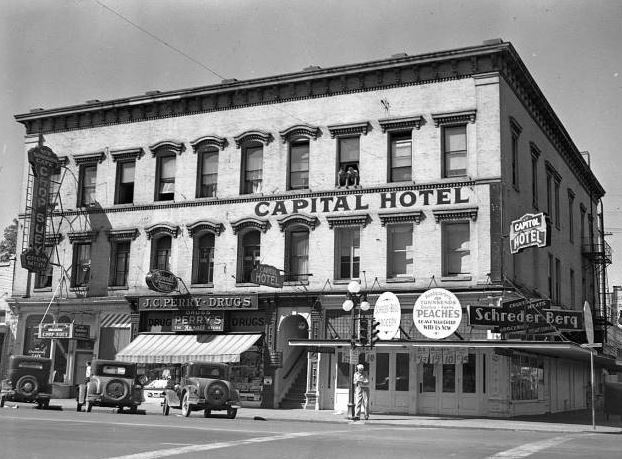
Oh yeah, some history...Here's the building that used to be on the corner:

Griswold-Murphy block, 1940 (Salem Library Historic Photos)

Same site today - streetview
And Harry Scott's first bike shop was around the corner and on the alley, on State Street.

Monday, February 5, 2018

Winter-Maple Family-Friendly Bikeway at Planning Commission Tuesday

Winter St alignment, May 18th, 1899
The Plan for the Winter-Maple Bikeway goes before the Planning Commission tomorrow evening, and the City will be asking for an endorsement. (Agenda and Staff Report.)

It's an idea that's been around since at least 1899, and maybe finally it'll have some juice behind it.

Staff recommends approval and endorsement
You may recall the tepid reponse that Bike & Walk Salem got last time a substantial bike plan went before the Commission. In 2011-12, it took three meetings, in December, January, and March before the Commission sent it to Council with a recommendation for adoption.

Back in 2011 the Planning Commission was lukewarm at best
Lots of citizens showed up in support, but the testimony somehow wasn't enough for a speedy and enthusiastic endorsement. Something was lacking. (It certainly wasn't that there were elements that needed further vetting.)

Sunday, February 4, 2018

New Book on Salem Clique needs more on Slavery

Matthew Deady, c1859
Oregon Historical Society
OrHi 63119
In the last couple of years the University of Oregon conducted a thorough reassessment of the legacy of Mathew Deady. Students had called for renaming historic Deady Hall on campus. In announcing the final decision not to rename Deady Hall, University President Michael Schill wrote:
Deady was...a deeply flawed man. He held racist views which I find abhorrent and contrary to the principles of our university. His support of slavery prior to the Civil War cannot be excused....Although Deady’s racist views did not abate after the Civil War, he fully embraced the new constitutional order....Deady supported the Fourteenth and Fifteenth Amendments, which guarantee to all equal protection under the US Constitution....Deady does not represent an example of an egregious case justifying overturning the presumption against denaming...[and] I will not recommend that the Board of Trustees dename Deady Hall.
In the same decision, Schill ruled that Frederic Dunn, an Exalted Cyclops in the second KKK of the 1920s, and who had taught at Willamette University between 1895-1898 previous to his time at the University of Oregon, was in fact an example of such "an egregious case." His name was removed from his namesake building, and it has been renamed Unthank Hall.

Matthew Deady was at the center of the "Salem Clique," the name of a small Democratic party machine mostly headed by Asahel Bush during the run up to Statehood in the 1850s, opposed first to a Whig coalition headed by Thomas Dryer of the Oregonian in Portland, to the Know-Nothing party, and then to the early Republican Party in the later 1850s.

Asahel Bush was almost certainly more racist than Matthew Deady, and it does not appear his views evolved the way Deady's changed. We know, for example, about his scorn for the efforts of Rev. Obed Dickinson and his wife Charlotte later in the 1850s and 60s.

Time to think more about Asahel Bush

A reassessment of the legacy of Asahel Bush is overdue. (We also need to know more about his real estate, investing, and banking activities later in the 19th century! He is such a key Salem figure, but hardly known in detail.)

In her new book, The Salem Clique: Oregon's Founding Brothers, Barbara Mahoney leans away from such a reassessment, and without denying the way race and slavery was implicated in our Territorial government and then the debate and drive to Statehood, she may not center it enough. Of Bush in 1862 she writes:
Writing in the third person...[he said] he was "in favor of maintaining the Government at every hazard and to the last extremity. He wouldn't destroy the Government either to enslave or liberate [yes, that word*]; he believes it to be a Government of white men, and if the liberties of that race can be preserved, he regards it of comparatively little consequence what fate betides [the same word]."
Rather than providing the central thesis and focus, this is an ancillary moment.

It seems instead like the machinations of the Salem Clique, starting with sending out Bush to organize the Democratic party from the very start, have at their basis the perpetuation of slavery in the South as supported by the Democratic party of the time, and arranging in Oregon a "Government of white men." Race and slavery are absolutely central here, both in our local politics and in the national political wrangling involved in admitting a new state to the Union.

Slavery isn't backstory or side story, it's absolutely central to the main story, and may indeed be the essence of the main story. (You might recall "Oregon Was Founded As a Racist Utopia," a Gizmodo piece from a few years back that pushes this argument.)