Friday, April 8, 2022

Ulysses S. Grant's 200th Birthday Coming Up

100 years ago Governor Olcott urged the celebration of the 100th birthday of General and President Ulysses S. Grant.

Issued May 1st, 1923, via Smithsonian

It will be interesting to see with our modest reassessment and revival of Grant's reputation if his 200th is celebrated much. There are intense cross-pressures at this moment in our history, and these may swamp any momentum to celebrate.

In 1922 Olcott noted indirectly that the generation of Veterans in the Civil War were nearly gone, and this might be "the last time we will have the opportunity of joining in a nation-wide celebration..."

April 8th, 1922

Olcott also said

The present generation may learn great lessons from the memory of General Grant, who as soldier, statesman, author is remembered throughout the world yet he arose from the common people and always was one with them.

May this day be fittingly observed that we may assist in the perpetuation of those lessons in our history which will keep our government and its principles inviolate for the generations yet to come.

This was written as the second Klan was gathering in Oregon.

Thursday, April 7, 2022

Details on Center St Bridge Seismic, Bike Rental System, and Climate in MWACT Packet

The Mid-Willamette Valley Area Commission on Transportation, an advisory board to the Oregon Transportation Commission and ODOT, zooms today at 3:30pm, and there are three items to note in passing.

The Center Street Bridge seismic project has been quiet, and it may need more funding. (Or perhaps ODOT wants to shuffle funding to free up money for some other project.) In the meeting packet is a note that the Federal Infrastructure Bill has a "Special Bridge" component, and ODOT is considering assigning money to the Center Street project.

New funding for Center St seismic?

This will hit the OTC in May and there may be more to say later on it. Perhaps more detail will emerge at SKATS or City Council also.

You may have seen the wrap on the OTC's meeting last month at BikePortland, "Transportation Commission makes final decision on $412 million in federal funds." In it was brief mention of a new program, the Innovative Mobility Pilot, whose funding was bumped up from $5 million to $10 million in the meeting. The Street Trust, formerly BTA, called it "a small, but important victory."

Tuesday, April 5, 2022

Bond Candidate List looks back to 20th Century Standards, not Forward to the 21st

The bond selection subcommittee met yesterday, and they are beginning round up a list for the total package.

Except it doesn't really have a shape.

It appears to be mainly a grab bag of old projects we haven't yet managed to fund. It might be better to have a real vision for it instead of merely a scattershot collection.

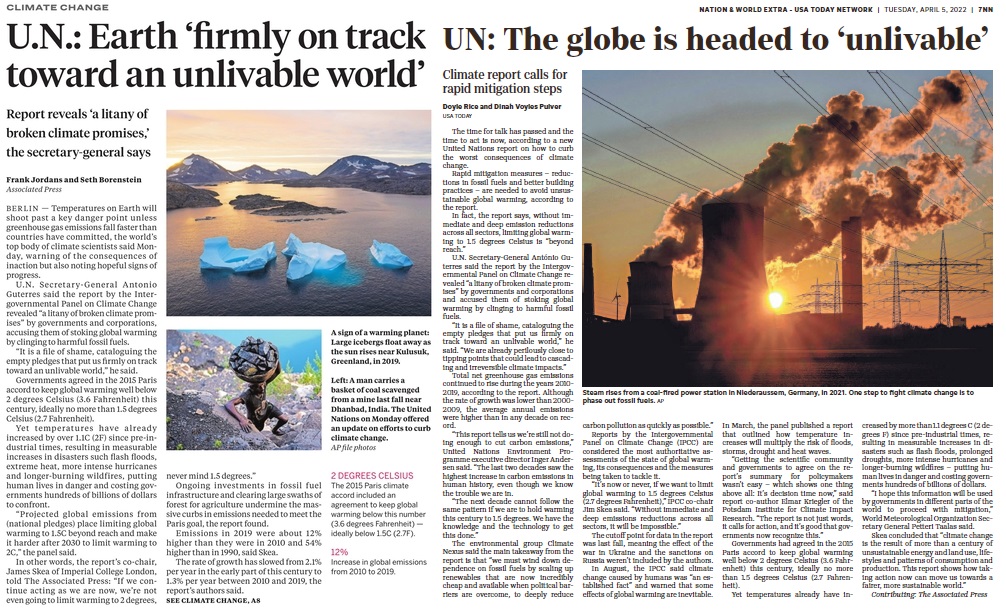
Local coverage today on the UN update:
Oregonian front page, SJ supplement deep interior

With the new UN Climate Report out, and our own Climate Action Plan a little stalled, and also with Our Salem still in progress, it might be prudent to hold off, and not send it to the ballot in November. For it looks still too strongly to 20th century standards, and not enough to our 21st century exigencies. Even when the projects were identified more recently, the designs and project scopes themselves respond to best practices of the previous century, not yet to a vision of the city we want and desperately need to have in 2050.

If this is going to be the big bond for the next 10 years, our big opportunity, shouldn't we be including more assertive climate action in it? Without a stronger sense of vision and values behind it, and instead relying on older lists of unfunded projects compiled under a different set of assumptions, the list feels more than a little ad hoc and a la carte. The process almost looks like a set of competitive applications for inclusion in the funding source. 

A better approach might be to ask what high-level outcomes we want and then to select projects that instantiate those.

Here are a few notes on a small number of transportation items. It's hard to grasp a pattern, and perhaps later there will be a better way to nutshell things. Or maybe you will see things more clearly.

Monday, April 4, 2022

Our Salem Continued at Planning Commission on Tuesday - More on Hubs

Unsurprisingly the Planning Commission continued and extended the Public Hearing on Our Salem. They meet again tomorrow, Tuesday the 5th.

Earlier in comment one person wrote to say, paraphrasing, that if they wanted to walk to a something like a Neighborhood Hub, they would have made a different choice of neighborhood. They were happy to drive one or two miles. Implied was the notion that the City had an obligation to retain the conditions in their neighborhood they found when they purchased into it. The City's job was to prevent change - or at least this change. Presumably they would not want the City to keep their property value exactly the same, however. They would desire and embrace the change involved in an appreciating asset. The City might discuss incoherence like that more explicitly.

The new, supplemental Staff Report also contains brief response to a number of the latest public comments. There didn't appear to be anything to cause a recommendation for any substantial changes.

Opposition to Hubs

There was a cluster of letters opposing Neighborhood Hubs directly, several of them borrowing language from a template using a form letter.

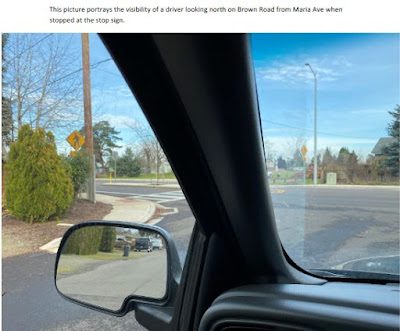
Here's an image from one letter criticizing a proposed Hub on Brown Road, saying the intersection with Maria Avenue remained "hazardous."

From a letter opposing a Neighborhood Hub

The corner structural bar at the drivers' side mirror is several inches wide. Is this about a poor location for a crosswalk or more about poor car design and the way structural elements in cars now reduce visibility and safety? From here this is obviously a problem with cars rather than a problem with crosswalks and intersections.

Sunday, April 3, 2022

Distracting from Driving: The Elephant in the Room

In the overlap of our housing crisis and our road safety crisis, this week the housing discourse has swamped most everything, erasing the driver and prompting a loss of focus as if we had one crisis only.

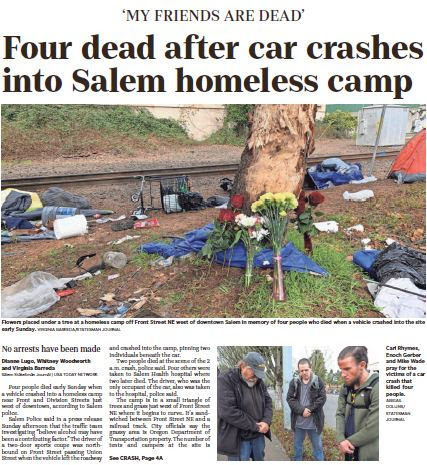
Back in February, and again last week, impaired drivers speeding recklessly on wide avenues, streets overdesigned for speed, left the roadway and killed people who were asleep.

An even earlier instance in 2017, via Twitter

In one instance people were inside a house. In another instance people were camping in tents. 

But instead of focusing on the problem and cause common to both, we have become distracted by the unsightliness of camping and assigned blame to it.

Back in February

Housing and the cost of housing is indeed a great problem. But having a house was no protection for Moira Hughes and George Heitz. You may recall also when a driver killed Srabonti Haque while she was sleeping in her own house (at top).

Instead of differentiating between the deaths of people sleeping in houses and of people sleeping in tents, we should see them as part of a common pattern of problem driving. The quality or cost or even location of one's home is a red herring here.

Front page last week

Newspaper coverage and especially other commentary generally also extended more sympathy to the couple housed permanently.

Driver kills Person on Cordon Road south of State Street

Thursday night a couple blocks south of the intersection with State Street, on Cordon Road a driver struck and killed a person on foot.

Cordon Road at Pennsylvania, looking south

From the Sheriff:

A few minutes before midnight on March 31, 2022, a 911 caller reported a pedestrian had been struck by a vehicle on Cordon Road SE near Pennsylvania Avenue SE in the unincorporated area of East Salem. Deputies and emergency medical services personnel responded to the scene, locating the pedestrian who was pronounced deceased at the scene....

Investigators determined a silver four-door Lexus was going southbound when the pedestrian was struck in the roadway. Investigators do not believe speed was a contributing factor to the crash. The 24-year old male driver remained at the scene; no citations or arrests have been made at this time.

The identify of the pedestrian, a 39-year-old female, is not being released at this time pending notification of the next of kin. [map link added]

Local governments are aware of a problem here, though they see it mostly as a problem of auto capacity, and less as road hostile to many users, and are moving slowly on planning. Back in 2015 the County applied unsuccessfully for a TGM grant. More recently has become a larger, joint project with the City of Salem. From the City a year ago:

Kuebler Boulevard SE, Cordon Road SE/NE, Hazelgreen Road NE, and Chemawa Road NE are classified as a Parkway in the Salem Transportation System Plan. Parkways serve as high-capacity, high-speed roadways that primarily serve regional and intracity travel. The Kuebler/Cordon Road corridor serves as the primary arterial serving the Mill Creek Corporate Center. The ultimate cross section for this corridor is intended to include four travel lanes, a landscaped median with turn pockets, and a multi-use path. This planning study will help prioritize future investments in this corridor and identify management strategies to promote safe and efficient operation for all modes of transportation. [italics added]

Language in crash reporting remains a problem also. It starts with the police template and press release, and then is subject to insufficient scrutiny and revision as it goes through other media.

Friday, April 1, 2022

Qing Ming, the Shrine Obscured, and George Sun's Frustration

Last weekend I tried to show an out-of-town visitor the Chinese Shrine at the IOOF Pioneer Cemetery. I could not find it. (See update below.) The last time I was by, a year or more ago, it had not been difficult to find. But this time it was. During the interval grass and other growth may have concealed it. Even with a map on the utility wrap, its location was not obvious, and if it is going to be part of our public history it should be more obvious and easy to find. It's still too much an instance of secret cemetery lore.

It was hard to navigate from this

This year's Qing Ming ceremony is this weekend, and there is still a ways to go on a full public history. Better visibility for the shrine might need to be a part of that.

Online, the SJ has a fascinating piece from the folks at the Mill, "Commemorating the groundbreaking life of a Salem Chinese American: Helen Ng Mun Tayne." I suppose it will be in the Sunday paper, and it will be very nice to see there. In it, there is an explanation that has been omitted from stories about the "Mayor of Chinatown," George Sun:

Helen Ng Mun Tayne was born on a hop ranch not too far away from Salem’s Pioneer Cemetery on April 28, 1906. Her father, Ng Lung Chung, rented the property from E.M. Croisan. As a first-generation immigrant from China, Helen’s father was not allowed to apply for naturalization or to purchase property in the United States. Ng Lung Chung, who also went by the name of Gong, was a skillful farmer. His 1910 harvest on the Croisan property produced what one newspaper declared “a phenomenal yield of over a ton of hops to the acre” — made even more remarkable because 1910 had been considered an off year for hop production. [italics added]

You may recall Hal Patton's 50th birthday celebration in 1922 at which George Sun spoke. His particular quote shows up on a different, downtown interpretive wrap, and in multiple places and texts elsewhere. It has become the go-to quote in the current retrieval of the history of Chinatown. But it is never actually interpreted, especially Sun's frustration at not being able to vote. That is a key part of the story, and should be highlighted, not glossed over in silence.

I like Salem because all people treat me nicely. Then my children all grow up. They can vote but I have been here so long, for fifty-four years next June, I ought to be a citizen. I ought to be voting too. I see some country- man come over to this country; he stay not very long, three or four years; he can vote. Why I be here fifty-four years altogether, why I cannot vote? I ought to be citizen too. They must make mistake, something wrong.

George Sun quoted at the Patton party
Interpretive sign on State and High

The reasons a person as eminent as the "Mayor of Chinatown" could not vote deserve a much fuller discussion whenever this quote is trotted out. The intended audience of those learning about Chinatown and local Chinese-Americans cannot be assumed to know the history of legislation and naturalization law. What exactly is the nature of the "mistake"? Shouldn't explaining this be part of the public history?