Showing posts with label Our Salem. Show all posts

Monday, May 20, 2024

Proposed Drive-thru Coffee Shack shows Weakness of MU-III Zoning

When we went through the Our Salem process and designated lots of the south end of Commercial Street in various flavors of "mixed use" zoning, and then subsequently went through a minor revision in the debate over overlay zones, and we talked about how much it was going to help us reduce driving and emissions, an important part of our climate action, were more drive-thrus really what we wanted?

Drive-thru coffee shack proposed

The City has an application for an additional car wash bay and wholly new drive-thru coffee shack for the corner of Judson and Commercial, very near the cemetery.

MU-III zoning here - City of Salem

The parcel is zoned MU-III, and in early returns, this new mixed use zoning does not seem to be inducing very much actual mixed use.

Staff Report from Our Salem, April 2022

More importantly, we continue to allow new drive thrus and all the driving trips they induce. No amount of PR on idling will change that! MU-III zoning was specifically formulated to allow drive-thrus. We saw this out on the new project east of Costco, and now here in a more inner neighborhood.

via FB

We should give more serious consideration to banning new drive-thrus altogether. Our Strong Towns group discussed this some last month.

(Since the MU-III zone is really a continuation of older commercial zoning, mostly just freshened up with a new brand name and a few more allowable uses, we should also consider renaming it to give a more honest high-level view of the amount and intent of actual mixed-use zoning. The City likes to brag about how much new mixed use zoning there is, but much of it seems very unlikely to be used in any spirit of mixed uses. There's too much PR on very theoretical and unlikely possibility and not enough discussion of realistic prospects. With more sober assessments we would be in a better position to iterate and refine so we are more likely to hit in reality our high level goals, which remain remote at the moment.)

Friday, April 5, 2024

Housing Production Strategy is Chance to Think Deeper about Our Salem and Climate Friendly Areas

The City's announced the start of the Housing Production Strategy project.

Salem needs more housing. To help meet that need, the City is creating a Housing Production Strategy (HPS) to outline how Salem plans to encourage housing development. The HPS is expected to include tools, policies, and actions that promote the production of a variety of housing types.

The published information is mostly prelude and throat-clearing rather than anything substantive.

They did publish a schedule, however.

The schedule (notes on step 2 added)

And one of the elements for this summer, ranging from spring to fall, is to "evaluate feasibility of developing housing in mixed-use areas."

Here, an ongoing criticism of Our Salem has been that the new mixed-use zoning, MU-I, MU-II, and MU-III was deployed in unrealistic ways, mostly along the biggest of our arterial corridors.

Much of the proposed change was
for arterial corridors
Our Salem map (2021)

So I hope the project truly grapples with the realistic prospects for housing in the new areas zoned for mixed-uses.

Are the big box stores, strip malls large and small, and parking lots going to convert to housing any time soon? 

What will the market be for warehoused housing right on top of our traffic sewers? If built to the concept in Our Salem, will people really want to live there?

And what is a realistic rate of change to housing for the downtown areas proposed for Climate-Friendly Areas/Walkable Mixed-use Areas?

Catalogue plans for apartments! - former twitter

More generally, we've already eliminated parking mandates, and there will be other ways to reduce costs of building housing. Hopefully the project will also support faster implementation of single-access apartment blocks (without the long corridors with two exits), which offer greater flexibility on lots and maximize housing. There's real potential here.

I hope this planning study asks real questions and generates real answers, not hype and puffery, but sober analysis and realistic forecasts.

Previously:

Wednesday, February 22, 2023

Warehouses on the Edges and Walkable Neighborhoods on the Interior: A Disconnect in Scale and Site

Earlier this month the LA Times had a story on big warehouses that "replace farmland and spew pollution."

LA Times, Feb. 2023

Yesterday the paper featured a front-pager on a supposed shortage in warehouse and industrial land.

It seemed to be written for multiple markets, for the Statesman Register Journal Guard Today, and its framing didn't correspond well at all to local conditions here in Salem. It was a misleading headline, alarmist, not a very good expression of any "objective" journalism. (It was, in fact, a kind of advocacy.)

Misleading headline yesterday

There had been just a few days earlier a story about another big warehouse and distribution center going up.

Saturday, July 23, 2022

City Council, July 25th - Our Salem and new Climate-Friendly Rules

Our Salem is already a little outdated. On Thursday the 21st the LCDC (the board) approved new administrative rules on climate and city planning formulated by DLCD (the State agency).

Cover of the Staff presentation to LCDC

Some of the rule changes will supersede or modify policies and code for Our Salem, which Council looks to enact formally with a second reading on Monday.

From the DLCD press release

I guess the benefit is now City Staff get to point the finger at the State when people complain, so in there is political cover in that sense. "Our hands are tied."

But it's also disappointing the City isn't following our Climate Action Plan and going further on their own. (See a little more on the passivity and reaction in "Climate Action Plan Committee: Transportation and Passivity.")

I am sure Staff will come to Council later with an update on another set of code and policy changes to bring Salem into compliance with the new rules. It will be interesting to learn where exactly are the new inconsistencies. There is also an explicit set of new tasks the rules assign to each city and area. (The chart is too abbreviated to be very legible, and obviously there will be more to say about it later - but it gives a holistic sense of more work to do.)

Salem area compliance tasks

In the meantime, at Council for Our Salem the second reading is broken up into four pieces:

Staff identify next steps:

  1. Update the Transportation System Plan to align with the updated Comprehensive Plan
  2. Update the Comprehensive Parks System Master Plan to align with the updated Comprehensive Plan
  3. Coordinate and implement strategies in the Climate Action Plan
  4. Conduct a new Economic Opportunities Analysis
  5. Conduct a Goal 5 inventory
  6. Develop a Housing Production Strategy

And to this we will add a seventh, which itself contains multiple actions (see chart above): 

7. Update everything for compliance with the new Climate Friendly and Equitable Communities rules.

Friday, July 8, 2022

City Council, July 11th - MLK Parkway

After the proposal to rename Center Street ran into difficulties, the effort shifted to the Parkway, and with blessings from ODOT and the Oregon Geographic Names Board, the way looks clear. 

On Monday Council looks to ratify and adopt the name change, to "Dr. Martin Luther King, Jr. Parkway."

To rename Salem Parkway

That seems like a fine move. The full name seems likely to be shortened to "MLK Parkway" in casual conversation, and the rhyme will help fix it in memory without any significant loss of meaning.

At the same time, it is a little odd that there is no public comment specifically in support of the shift from Center Street to the Parkway yet from our NCAAP chapter or Oregon Black Pioneers. More comment is sure to come over the weekend.

Here's how many Salemites would have been introduced to Dr. Martin Luther King, Jr., in what appears to be his first substantial notice in the paper, when he was arrested "on charges of violating Alabama's anti-boycott law" in 1956. His house, the piece in the afternoon paper points out, had been bombed the month before while he was leading the boycott. The morning paper does not appear to have published anything about him. Its corresponding piece about the boycott on February 23rd, and in immediate follow-up the rest of February, mentions Rosa Parks only. (See also an earlier note on the boycott that also mentions her, December 6th, 1955. Gaines Street still seems worth more discussion as a candidate for reconsideration.)

February 23rd, 1956

In other action, Council will get an information item on the initial approval and subsequent appeal of a proposed food cart pod in West Salem at Riverbend Road. The appeal claims there is not enough parking, will be too much noise, more garbage and rodents.

Friday, June 10, 2022

City Council, June 13th - Street Painting and The Woods

At Council on Monday they look to ratify the code for street painting and intersection murals on neighborhood streets. With it is also some administrative rule-making.

Not permitted?

Designs shall not contain words in any language, letters from any alphabet, numbers, universally recognized signs, symbols, emblems, or logos of any kind....Designs shall not create an [three-dimensional] illusion that may be misinterpreted as a safety hazard by a motorist or bicyclist.

Earlier this year Strong Towns had a note that referenced drivers swerving dangerously for 3-D optical illusion crosswalks. So that's a real thing apparently.

And a kind of 60% supermajority is potentially required:

The proposed street painting shall be denied if objections are received from more than 40 percent of the abutting and adjacent property lots.

Four finalists for design in Grant

It will be exciting to see the first painting, likely the one proposed for Cottage and Belmont, and tentatively scheduled for painting over the Fourth of July weekend, and then to iterate on the rules as seems useful. (Previously here and here.)

Abandoned concept for The Woods

The long rumored transfer of "The Woods" at Fairview is also on the agenda to be formalized. The parcel had been proposed for large lot development back in 2019 by Eric Olsen, but the application's language was weird. After the City approved it, a citizen appealed to LUBA, and LUBA agreed there were problems, so much so they reversed the decision rather than merely remanding it.

So now the solution seems to be donating the land to the City rather than trying to develop it or to keep it as privately owned park land. Interestingly, it is not Eric Olsen donating it, but a successor to the original Sustainable Fairview, SFA2. Maybe Eric Olsen never closed on it, or perhaps he sold it back. That's probably not an important detail, but it is interesting to note.

The transfer could impact timeline or funding for construction of the future segment of sidewalk along Battlecreek/Pringle Road, but the Staff Report identifies impact only to "a performance security," and not to construction itself.

This makes two large chunks of the former Fairview property now publicly owned as park or quasi-parkland.

Monday, April 4, 2022

Our Salem Continued at Planning Commission on Tuesday - More on Hubs

Unsurprisingly the Planning Commission continued and extended the Public Hearing on Our Salem. They meet again tomorrow, Tuesday the 5th.

Earlier in comment one person wrote to say, paraphrasing, that if they wanted to walk to a something like a Neighborhood Hub, they would have made a different choice of neighborhood. They were happy to drive one or two miles. Implied was the notion that the City had an obligation to retain the conditions in their neighborhood they found when they purchased into it. The City's job was to prevent change - or at least this change. Presumably they would not want the City to keep their property value exactly the same, however. They would desire and embrace the change involved in an appreciating asset. The City might discuss incoherence like that more explicitly.

The new, supplemental Staff Report also contains brief response to a number of the latest public comments. There didn't appear to be anything to cause a recommendation for any substantial changes.

Opposition to Hubs

There was a cluster of letters opposing Neighborhood Hubs directly, several of them borrowing language from a template using a form letter.

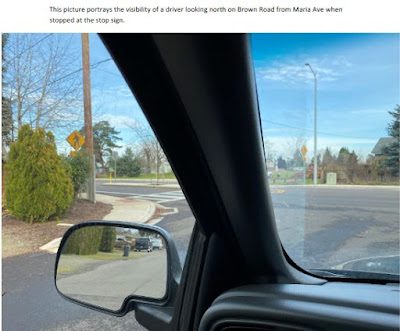
Here's an image from one letter criticizing a proposed Hub on Brown Road, saying the intersection with Maria Avenue remained "hazardous."

From a letter opposing a Neighborhood Hub

The corner structural bar at the drivers' side mirror is several inches wide. Is this about a poor location for a crosswalk or more about poor car design and the way structural elements in cars now reduce visibility and safety? From here this is obviously a problem with cars rather than a problem with crosswalks and intersections.

Tuesday, March 15, 2022

Our Salem at the Planning Commission: Make it Stronger

The Planning Commission will hold a Public Hearing on Our Salem tonight, Tuesday the 15th. (The Staff Report and materials are split oddly between the Commission page and Our Salem page.)

At this point there is little new to say. Public Comment has focused down to the micro scale. Nearly of all of the comment in February is variation on this form:

I live near/I own such-and-such lot and I love/hate the proposed zoning changes.

That's it. It's all nitpicking or nit-praising. Mostly nitpicking.

Legibility in Proposed Zoning change maps
May 2021 (left), March 2022 (right)

The way the map of proposed zoning change areas has developed really hides the main structure (see the March 2022 map) and makes you zoom in to see fine detail in order to grasp anything. So perhaps it is not surprising that comment has gone this way. The zoning scheme is also way too complicated, and we should have simplified more. At a glance, what does that March 2022 map say?

We need to go back to the macro, to see and assess the plan as a whole. Here are the main points from here:

  1. Attention is now too much on individual trees and we've lost the forest.
  2. Even with the provisions of HB 2001, we still are insulating neighborhoods from change and focusing change on arterial corridors.
  3. If we insist on concentrating change on arterial corridors, we shouldn't leave street reform as an ancillary matter for the Transportation System Plan, but should center it more in Our Salem itself. It needs to be primary, not secondary.
  4. If climate is urgent, but seems too gradual and distant, a war and rising gas prices focus more immediate attention on geopolitical problems of fossil fuel, and we should center that frame in our analysis and debate.

The Forest: High-level Goals and Plan Structure

Whatever happened to our "Indicators" and the "Report Card"? The Report Card was last updated in the Spring of 2019, and there has been a number of changes, many of them deletions and reductions, to the plan concept that was the current draft then.

Thursday, March 3, 2022

Cherriots and Our Salem should give more Thought to Future BRT

Between the military ambitions of a petrostate autocrat, rising gas prices, and our need to reduce emissions, maybe it's the time we will finally reconsider our relation to petroleum.

Micro scale - via Twitter

And Macro scale - via Twitter

In a side conversation a few days ago, and speaking only personally, the person who is also Board Chair of Cherriots suggested an interest in planning for Bus Rapid Transit in Salem. That was great to see!

Surprising leading candidate - via Twitter

I had thought that Lancaster Drive was the most likely candidate as it had the highest ridership, but he suggested instead South Commercial Street might be the most promising, especially with the prospect of a forthcoming transit center in South Salem.

Monday, February 21, 2022

First Response Time Shows Cost of Development on City Edges

Yesterday's story about fire response times missed an opportunity to connect with a more general analysis of proximity, travel time, and land use, and to connect then with Our Salem.

Front page, Sunday

You might recall this from a few years back.

Emergency response times in Salem
(Kailuweit for Council, 2016)

Though the paper shows no map, it is very likely that Sunday's article discusses a pattern nearly identical. (See previous discussion here.)

The problem of fire response time gets framed up as some neutral consequence of city growth, but it in fact is an artifact of our policy preference for growth on the edges of the city in new greenfield development with single detached housing set on large lots at autoist spacing.

Thursday, December 9, 2021

Apartments may be Needed to Support Hubs: New Activity at the Bone Parcel

You might recall a decade ago the Neighborhood Center Mixed Use zoning. Though it was supposed to be available more generally for sites around the city, it was specifically formulated with the Bone parcel at Chapman Corner in West Salem in mind.

Previously:

For whatever combination of reasons, the new zoning did not yield a new mixed use development. And other developers around town have not found it useful zoning. The NCMU concept is very dormant.

Now, after a decade, the developers are asking for the northern part of the property to be zoned for apartments. The southern part, at the intersection, would remain zoned for mixed use.

New apartment zoning

As with the Fairview projects, this should be a case study, an example of a kind of forensic analysis, for Our Salem. Why didn't it develop? What ingredients were missing? Are there any lessons from this project and the NCMU generally for the Neighborhood Hub concept? In Our Salem, the City is missing closer analysis of empirical data from right here in Salem.

The hypothesis here on the blog is that nearby swaths of single detached housing do not provide enough people, enough prospective customers, to sustain business activity in a neighborhood center or hub. (At the same time, the applicant has "Bonaventure" in their name, and it may be this is for a retirement home. If they are active, they could patronize businesses in any NCMU developent, but if it is any kind of assisted care, residents probably would not.)

With an adjacent apartment complex, the critical mass of customers might be created.

This is evidence that even with the State making fourplexes legal in zones for single housing, the rate of changeover will mean that there still are not enough people to support Neighborhood Hubs nearby, to support new transit routes or higher frequency, and to make meaningful changes in travel away from drive-alone trips.

As for this proposal specifically, there may be more to say when the Staff Report comes out. The Hearing at the Planning Commission is scheduled for December 21st.

Sunday, December 5, 2021

City Council, December 6th - Our Salem and Middle Housing Code Update

The front page of the Sunday paper has a big piece on climate disruption. It's oddly framed, a little like an investigative report that is presenting some hitherto unknown set of facts. But apart from that oddness of tone, and the mention of causation a little deep in the piece, it clearly points at greenhouse gases.

Climate on the front page today

From the piece:

Reporters read thousands of pages of climate assessments, scientific papers, weather reports and government documents. They interviewed more than 70 people, including climate scientists, academic researchers, local and federal officials, and residents forced from their homes by drought and flood.

Taken together, the reporting reveals a stunning shift in the way precipitation falls in America.

(There were other articles on water, too: "Rockies winter starts with whimper, Experts: Drought could threaten water supply" and "How Midwestern rainfall poisons the Gulf of Mexico.")

Deeper in the paper, the Council preview doesn't link up much with the front page. It leads with the prospect of drastic change, but not the change we are already experiencing. This rhetoric will trigger loss aversion. It's a little alarmist. The piece doesn't start with the existing drastic changes from climate, like those discussed on the front page, and our urgent need to reduce our emissions and adapt to changes already in process that cannot be stopped.

"drastic"

That push-pull ambivalence is probably all too accurate.

In addition to getting an update on the Climate Plan, Council looks to initiate adoption of Our Salem. The next step would be a formal Public Hearing at the Planning Commission next year.

Monday, November 15, 2021

Two Venerable Properties: Truitt Bros. Cannery for Sale and Fitts Seafood perhaps Sold

The Monday paper has a nice piece that ties the sale of a set of historic cannery buildings and land to the mixed-use zoning proposed in Our Salem.

Dehydration hype, Canning Age, January 1920

From the piece:

“We’d love to see waterfront housing — three- to four-story apartment buildings with a main commercial floor,” [owner Jordan Truitt] said. “I would love to see the existing buildings stay and the greenway stay and be repurposed.”...

He said the new Mixed-Use Riverfront zoning for the property proposed in the city’s “Our Salem” project would open the door for the Truitt brothers’ vision for a revitalized waterfront like those seen in other northwest cities.

Front page today

Previously from 2017, "Truitt Bros Building on Market and Front to Celebrate 100th."

Fitts Sold?

There have been rumors that Fitts Seafood has sold, and while its storefront is not the commanding riverfront property the cannery enjoys, it is an even more venerable enterprise, having started in 1901.

Friday, October 15, 2021

City Council, October 18th - Work Session with Planning Commission on Our Salem

Earlier this month the paper's layout on the front page juxtaposed stories on our onset of our seasonal coastal "hypoxia zones" and on a debate over an undeveloped parcel in south Salem. The development story reran a couple of days ago.

Front page, October 3rd, inset Oct. 13th

This pair is one good frame - there are others of course - for the proposed revisions to our Comprehensive Plan. Council and the Planning Commission meet for a joint Work Session on Monday the 18th. So far we are unwilling to make land use subordinate to our unfolding climate emergency. Instead, we want to insulate our neighborhoods from change, whether that be apartments, pallet shelters, and sometimes even single houses. Especially parking. We want to make climate subordinate to our current living arrangements. But we know who will have the last word.

Oregonian, June 2021

Monday, October 11, 2021

New TDM Framework for Portland can Illuminate Our Salem and Climate Action Plan

In advance of thinking more about Our Salem and the Climate Action Plan, today's note at BikePortland, "Portland has a new plan to persuade you to stop driving so much," points not just to a new plan with a new approach to Transportation Demand Management actions and policies, but also a theoretical framework for evaluating our proposals that touch on transportation in Our Salem and the Climate Plan.

"The Way to Go Plan"

The Way to Go Plan discusses nine strategic priority areas.

They write about the inadequacy of a carrots-only approach:

Many transportation demand management programs focus on initiatives that offer information and encouragement for people to try new modes (like transit or biking). While these are important tools, the city cannot reach its ambitious climate, mobility, and equity goals with informational and encouragement programs alone.

To most effectively manage demand for the city’s transportation system, PBOT needs a toolkit of strategies that address the multifaceted nature of human travel behavior, employing strategies that reduce travel demand or redistribute demand in space, in time, or by mode...


A summary of the nine strategies

The top two strategies involve pricing, one with costs, the other with rewards.

Fees, charges, and tolls—designed intentionally and equitably to manage demand—send price signals that help people understand the true costs of driving and encourage non-driving choices when possible. One example of pricing is charging a daily rate for parking your private vehicle.

Especially in tandem with pricing, financial incentives—such as discounted passes, subsidies, and reimbursements—make using travel options more cost-competitive, and can increase motivation to try new ways of getting around.

We will come back to this, to read the plan in more detail, to see how it is received in Portland, to see what revisions might be made before final adoption, and also to consider it as a theoretical framework for evaluating Our Salem and our Climate Action Plan. It could be a fertile prompt for additional analysis and policy action.

Sunday, October 10, 2021

City Council, October 11th - Our Salem, MUHTIP, Marine Drive

Council convenes on Monday and one of the items is cueing up the formal Work Session next week on Our Salem and the proposed new Comprehensive Plan.

Transportation in the 1973 Comp Plan

There will be more to say next week, but without diving in too deeply, the language in the current draft proposal may be too loose and subjective, too oriented to hopes and wishes, without measurable standards to assess progress, and it may reproduce the some of the same problems in previous editions of the Plan that didn't really get us to where we said we wanted to go.

Two generations ago, in 1973 we seemed clear on "differences in the social costs and environmental impacts" in transportation, but how much progress have we made on remedying and correcting for them?

The current draft

Current draft, continued

A document on additional ideas

When we "pursue strategies," "increase access," "accommodate," "employ strategies," and "decrease reliance," these are all things that can be understood as satisfied without any actual change in driving and VMT by Salemites. It is too often signalling of good intentions without substantive change.

There will be more to say next week.

Tuesday, September 28, 2021

Proposed Subdivision in South Salem Shows Problem with Single Detached Homes - Updated

With street names like Walton Way, Ramsay Road, Aldridge Avenue, and Drexler Drive, a new subdivision of 138 single detached houses proposed for the field and woods just north of the future Hilfiker Park, between Fairview and Trader Joes basically, appears to aim for a certain sports-loving niche.

Nearly 30 acres into 138 lots for single houses

But the project may not be a slam dunk. 

Its timing may be to ensure that it gets approved before Our Salem is finished, but it represents a missed opportunity in multiple ways. 

At an earlier draft stage of Our Salem, the lot and a band of lots to the south of it were proposed for Multiple Family Residential 2 zoning.

Meyers Parcel proposed in Spring 2021 for RM2

You can see from the red pins that the concept elicited a number of comments in the Spring of 2021.

Friday, August 13, 2021

City Deletes Three Fifths of Proposed Neighborhood Hub Sites in Latest Revision for Our Salem

The City announced a revision to the neighborhood hubs for Our Salem. The way the information is presented, it does not appear we are to register very much other than that the City killed some. It would have been more helpful to see them isolated, and not on a map already cluttered with detail. The information design here really buries the matter.

Deleting 21 proposed hub sites - City presentation

Here they are isolated - but even this was a view the City never presented and had to be created by deselecting a bunch of layers in a map, and the most recent version of the map has layers collapsed so you can't deselect and isolate individual changes.

The proposed hub sites in February 2021

There is also little explanation with the announcement:

View Proposed Changes to Neighborhood Hubs

We have made changes to proposed neighborhood hubs based on community input and analysis. Those changes include:

  • Reducing the number of proposed neighborhood hubs by nearly two-thirds
  • Adding restrictions to the types of uses allowed in proposed hubs and adding additional standards

Any overarching goal of reducing emissions or any kind of holistic view do not seem to be driving the deletions. Instead, NIMBY sentiment and neighbor complaint appear to be driving the changes.

Saturday, July 31, 2021

Problems with Seattle's Urban Villages might Prompt more Thought on Our Salem

The other day the Seattle Times had a front page piece on their "urban village" zoning concept from a generation ago.

The idea was to accommodate newcomers, revitalize the city and curb sprawl in the suburbs. The strategy, adopted in the 1990s, funneled new apartments, townhouses and condos into about two dozen neighborhood hubs, along with shops, parks and buses.

Nearly 30 years later, with Seattle’s population approaching 800,000 and the median home price recently topping $900,000,”it’s time to probably refresh,” Rice said in a recent interview....

The analysis recommends that the city change its zoning laws to allow more housing types in areas outside the urban villages that are now reserved for single-family homes. It also recommends the city adopt strategies to support low-income residents and residents of color who want to rent or own homes throughout the city.

Seattle Times, front page July 2021

Seattle's plan of course was for a metro considerably larger and more urban than Salem, with hubs commensurately larger also, but there are still some analogies with our hubs and the considerable swaths of mixed-use areas proposed along the great arterial corridors in the current draft of Our Salem.

Much of the proposed change is
for arterial corridors
Our Salem map

If problems with the detail don't always match up, problems with the general structure and vision do.

Wednesday, July 14, 2021

Zoning Subcommittee Meets for Final Time on Thursday the 15th

The Zoning Subcommittee for Our Salem convenes on Thursday the 15th for the final time, and they appear to have a consensus on the six zoning concepts.

Draft recommendations added in blue

Intro to the summary memo

From here, they don't quite come into full focus as a coherent approach or something that is really at the right scale yet.

Eliminating parking requirements and allowing more generous building heights seem reasonable.

Adjusting minimum density in mixed use and multifamily areas from 12 to 15 homes per acre seems very marginal. 

But the last one, adjusting single family residential near the core network to 15 homes per acres is stronger. This is "the density at which drivable suburbanism transitions into walkable urbanism."

You can read the full summary here.