Showing posts with label SKATS. Show all posts

Monday, January 27, 2025

New Project Scoring possibly Revised: At the MPO

The Policy Committee for our Metropolitan Planning Organization meets tomorrow, Tuesday the 28th.

NY Times earlier this month on LA fires

It was a little disappointing to see the technical committee earlier this month with a move to invite the Policy Committee to adopt a scoring rubric "scaled back" from a staff recommendation for stronger weighting on safety, transit, filling in gaps, and greenhouse gas reduction.

The proposal earlier this month

Public comment was overwhelmingly in favor of stronger consideration for these factors, and the technical committee seemingly suggests watering them down.

Thursday, January 9, 2025

EV Charging and Revised Scoring Rubric at the MPO next Week

The LA conflagrations, whipped by a Santa Ana and intensified by our changing climate, dominate the front pages today. Even the east coast papers lead with it.

Front pages: NY Times (top)
Washington Post (bottom)

Our local paper leads with news that we are sending firefighters to assist.

Front page here

The catastrophe is a climate story in addition to a land use story and everything else.

The MPO has two meetings next week in a somewhat irregular schedule and there are incrementally good things to see on climate action.

Tuesday, November 19, 2024

A Survey on Priorities for 2027-2032 Funding at the MPO and a Nice Story about an old Oak on Gaiety Hill

Our Metropolitan Planning Organization started a survey for preferences in scoring, ranking, and ultimately choosing projects to fund in the next 2027-2032 cycle, in which about $28 million is expected to be available.

Safety and Climate head the list

The survey design is a bit dodgy. At the top of the list are high level values like "climate" and "safety." But the next item is "reduces a gap," much more specific. The level of generality is not at all consistent.

They also jam together disparate elements. Safety and security have different connotations. The problem of greenhouse gas is acute and chronic right now in a way the problem of carbon monoxide is not. It wasn't necessary to mention carbon monoxide unless you deliberately wanted a path to old-school congestion relief.

Some of the categories overlap. Reducing gaps also increases access. Improving transit also reduces greenhouse gas.

And the very great problem of speed is not mentioned.

With the way the survey is constructed, it may not be possible to give the MPO clear signals about what to prioritize.

Still, take the survey and reply more fully in the free response box towards the end. Safety and climate deserve more attention!

An Old Oak

The Oak at High and Oak Streets on Gaiety Hill

Salem Reporter has a lovely story about the prospect of cutting down the old Oak at the intersection of Oak and High at the crest of Gaiety Hill, right by the Smith-Fry house of 1859.

Monday, September 23, 2024

A Safety Plan too Aspirational and Questions on Front Street: At the MPO

The Policy Committee for our Metropolitan Planning Commission meets on Tuesday the 24th to adopt the new Metropolitan Transportation Safety Action Plan.

Ticketable: On Commercial between Hoyt and Rural

The MPO did not in the end incorporate more of an emphasis on system speed and legal, lawful posted speed, which are often too high and too lethal for an urban area. They focused more on speeding above the posted speed.

Previously:

The edits from the August draft to the September final version are mostly small.

Perhaps the most consequential set of edits undercuts the document as any kind of "action plan."

Merely a "guiding framework"

The plan doesn't actually commit the MPO or its members to doing anything. It is mainly aspirational, merely a "guiding framework" and list of "recommended strategies." It's more hope than plan.

Monday, August 26, 2024

Public Comment Calls for more Attention to Speed and Speeding in draft Safety Plan: At the MPO

This summer Wes Marshall's book, Killed by a Traffic Engineer: Shattering the Delusion that Science Underlies our Transportation System, came out.

via the former Twitter

One of its themes was the way safety is absorbed into and equated with congestion relief. High congestion equals low safety; low congestion and free flow equals high safety.

The old bromide, Killed by a Traffic Engineer

At the MPO last month a Salem transportation planner articulated just this notion, which is also a policy of appeasement. The driver stuck in traffic is on this view the safety problem. We must appease drivers in any hint of congestion and make it easier to go faster. The most dangerous thing, the thing to be avoided nearly at all costs, is the pissed off driver.

Rewarding aggressive, bullying driving

By contrast, in a preliminary review of public comment on the draft Transportation Safety Action Plan being presented to the committee on Tuesday, "the majority noted that reducing speeds on the roads is the main factor in creating safe travel...most felt that the plan does not address safety and speeding enough."

Its focus was not on drivers irritated by congestion. Its focus was on drivers going too fast.

More focus on speed and speeding please

Speed and speeding are not the same, and more attention should also be given to the lethality of legal, posted 40mph speed. With the way we enforce traffic laws, we tolerate an ostensibly banal level of speeding up to 50mph on such a road.

Why is this induced, supposedly licit behavior, not also considered "risky driving behavior"?

We really need to face more squarely the tension, even contradiction, between a primary frame of "congestion relief" and a primary frame of "safety."

Friday, August 2, 2024

Salem-Keizer Transportation Safety Plan needs more on Speed, not just Speeding

Yesterday our Metropolitan Planning Organization announced the release of the draft Metropolitan Transportation Safety Action Plan.

On Monday they will start taking comment on it.

We will have an online Open House outlining the major plan elements and asking for your feedback which will be listed here when open. The Open House runs August 5th through August 14th.
Draft Plan, August 2024

While one of its 16 recommendations is for more automated photo speed enforcement, it does not give enough attention to speed generally, including lawful, posted speed. The seed of the idea is there, but it is not developed and centered enough.

"Kinetic energy" sounds like military talk

The plan employs a "safe system" structure, which on the whole is a positive development. But it still bogs down sometimes in jargon, and this often corresponds to weakness in the analysis itself. One moment of jargon is the shift from talking about speed to "kinetic energy." From a pure scientific description of the energy in collisions this might be reasonable, but it also sounds like something borrowed from military jargon and a euphemism for warfare.

When we talk about speed and anything kinetic, we are talking about the speed of drivers and cars. We are not talking about the kinetic energy of a person on foot or even a person on bike. This jargon obfuscates, and diffuses responsibility from the drivers and the safe operation of motor vehicles onto "shared responsibility."

Tuesday, July 23, 2024

Speeding is the Baseline in Congestion Analysis: At the MPO

The Policy Committee for our Metropolitan Planning Organization, SKATS, meets today the 23rd at noon, and there are just a couple of short notes here.

Earlier this month, SJ and NY Times

The technical committee, you may recall, started the conversation about priority areas in the next short-term plan for 2027-2032.

Completion, Safety, and Climate Friendly rules

They identified finishing projects with completion funding, more focus on safety, and better alignment with the current planning effort for climate-friendly areas.

In the discussion of congestion for the Policy Committee, they also conceded that the baseline in analysis of congestion is speeding, that the "free flow" conditions against which delay, slowing, and congestion are measured assume travel above posted speeds.

Recognition that the baseline is speeding

This is good, but it's still framed up as just something small to consider in the analysis, a minor detail that doesn't really affect the larger picture, and not any fatal flaw in the whole paradigm of congestion relief. So there's still a ways to go in highlighting the contradiction and incoherence between a safety paradigm that calls for slower speeds and a congestion relief paradigm that calls for higher speeds.

The Policy Committee meets at noon today, Tuesday the 23rd. The agenda and meeting packet is at the calendar item.

Monday, July 8, 2024

Remember the Heat as the MPO Starts Thinking about the MTIP

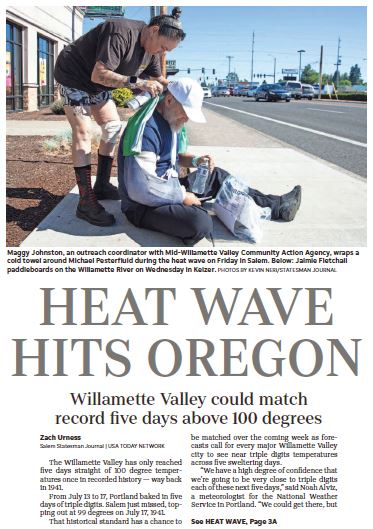
In Saturday's front page piece about a record-setting potential for five consecutive days of 100 degree weather, the tone seemed more about gee-whiz excitement at breaking the record than warning about the danger. Above all, climate change and the probability of more heat waves like this was wholly absent from the piece.

The paper ignored climate

By contrast, the day before in a piece from OPB, the new agency head at the Department of Water Resources was clear on climate, and specifically pointed to "policymakers and agency leaders."

The day before, a story on water centered climate

Even today, climate is directly adjacent in a national story off the wire, but a little denied in the local coverage by the trope of water play and fun.

Friday, May 24, 2024

Safety at the MPO

A year ago the MPO project to write a Metropolitan Transportation Safety Action Plan held an open house and survey. They've published a summary now, and it is interesting to consider a little.

The Policy Committee for the MPO meets on Tuesday the 28th, but there's not really anything much to say on that agenda, so we'll talk about that safety plan instead.

Survey summary

The results in general do not seem very surprising: People feel more safe walking than biking, people really feel vulnerable while on bike, intersections are a problem, and people feel safe in their cars.

Leveraging the precarious feelings of being on bike to support better bike lanes is wholly warranted.

But should messaging also underscore that you are not as safe in your car as you might think?

A few days ago

Just a few days ago the husband or relative of retired Librarian Judy Brunkal lost control of his vehicle on Croisan Creek Road, and she died in the crash.

In February a passenger, Lynda Rohrback Bush, died when her driver apparently tried to sneak across 12th street at Oak Hill in south Salem.

The lethality of autoism claims as many lives as gun violence.

It's not just those on foot, on bike, or otherwise rolling, who are at risk.

When he was at the paper, Dick Hughes used to say "Driving is the most dangerous thing that many of us will do in our lifetimes." 

Maybe in a strict actuarial sense this isn't the best way to put it, but he was right to underscore the dangers of driving! Drivers are the author of calamity.

One of the best things a transportation safety plan could do is say loudly and often, "Driving is dangerous and employs lethal force. The drive not taken is the safest drive. As often as you can, don't drive." Not-driving meets the exigencies of our moment: Climate as well as safety.

Pushing back on the illusion of safety when a person is inside a car would be salutary.

Monday, April 22, 2024

By a Divided Vote, SKATS Finds Path for Aumsville to Join: At the MPO

On Tuesday the 23rd, the Policy Committee for the Metropolitan Planning Organization meets. Last month they did what had seemed increasingly unlikely. They voted to add the City of Aumsville and to add an additional voting representative from the City of Salem.

A substitute motion

You will recall that Mayor Clark of Keizer and Chair of the MPO had introduced a motion to add Aumsville to the MPO without any changes to the voting structure.

The original motion

Councilor Phillips of Salem offered first a friendly amendment for Salem to have an additional seat and vote on the Committee, and after it was not seconded this became a substitute motion.

After a good bit of debate, Mayor Clark called for the vote and herself voted for it. It passed 4-3, with Marion and Polk Counties and the City of Turner opposed.

Calling the vote

It had not seemed likely that Mayor Clark would support Councilor Phillips and the City of Salem. So that was a nice surprise.

Still, there was some maneuvering. Commissioners Mordhorst and Cameron of Polk and Marion Counties respectively proposed to eliminate the School District from having a vote. If that happens, that might dilute the new vote from the City of Salem.

It should not happen. The School District has a vital interest in traffic safety and Safe Routes to Schools. And since SR2S staff are now employees of the COG/MPO, it is appropriate for the School District to sit on the Committee and to vote as part of it.

This is something to watch.

More than a bike rodeo!

In the miscellaneous updates for the current meeting it was great to read that a multi-week Bicycle Safety Education course would be returning to Salem schools after an absence of a few years, having been very incompletely replaced by bicycle rodeo concepts. (See "Bike Safety Education and the Hammond Bike Train" from 2010 for a brief hit on an earlier example of multi-day Bicycle Safety Education.)

The Policy Committee meets Tuesday the 23rd at noon. Meeting information, agenda, and packet is here.

Sunday, April 7, 2024

Incoherence on Emissions, Congestion, and Safety: At the MPO

The technical committee for our Metropolitan Planning Organization meets on Tuesday the 9th, and they should, but likely will not, face the incoherence in our dominant autoist paradigm.

Frames for less driving vs more driving

Right now the policy conversations on greenhouse gas emissions and on congestion relief are disconnected. They each happen in a vacuum as if the other was not happening.

Our need to reduce emissions from driving means less driving and slower driving so that non-auto transportation is safer and more comfortable.

But our wish for congestion relief means faster driving and more driving from induced demand.

We need to connect the two discourses and make congestion relief secondary to greenhouse gas reduction and to safety.

How seriously will they take this?

I am not sure at the moment that the technical details of picking a particular target measure are all that critical.

Sunday, March 24, 2024

Showdown on Aumsville: Drama at the MPO

On Tuesday the 26th, at the MPO is a showdown on how to admit Aumsville.

Showdown!

The conversation and debate last month led up to this. 

Since at least June of last year it has been known that the Feds had ruled that Aumsville was going to be joining the metropolitan area for the MPO. So how to add them? There was some flexibility on this part. The most simple way, and the way that was used 20 years ago when Turner was to join, was to give Aumsville a single representative and vote on the Policy Committee. This is to take the mode of the US Senate rather than the US House, a mode that gives very small jurisdictions and their residents the same voting weight as very large jurisdictions and their residents.

The City of Salem and Cherriots are interested in rebalancing things with a somewhat more proportional representation.

In February the Mayor of Aumsville, with 4,200 residents, said that "the city of Aumsville's voice will be diminished if Salem is provided additional votes."

One vote for 4,200 residents vs. 175,000

Mayor Hoy pointed out that Salem has 175,000 residents, whose voice is very diluted if they have the same voting weight as the 4,200 of Aumsville. Mayor Hoy asked for "fair and balanced representation."

175,000 residents vs. 4,200

Councilor Philips offered some additional math: "the city of Salem is equal to 42 'Aumsvilles'."

Salem = 42 Aumsvilles in population

The Mayor of Turner asked if Salem had had two votes, what would have been different.

Sunday, March 10, 2024

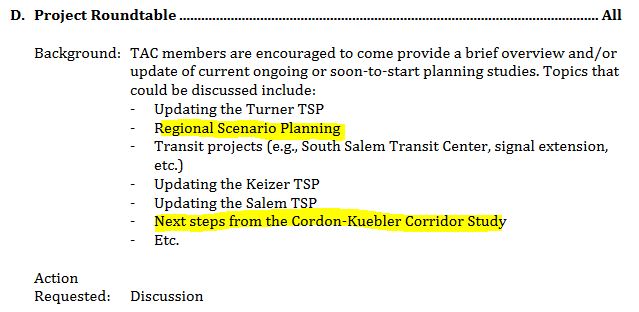
Will Scenario Planning just Restate the Obvious? At the MPO

The technical committee for our Metropolitan Planning Organization meets on Tuesday the 12th, and while there's no specific action item to comment on here, a broader and freer "project roundtable" discussion is a good hook for a couple of comments.

A couple of "roundtable" items

The Scenario Planning project has already garnered some informed concern about its methods and work products, chiefly that as it is currently organized here, it's not going to tell us anything we don't already know. A person with long experience generally and specific knowledge of the modeling package writes:

it is so high level ("strategic") that it largely tells us what we already know: our existing plans will fall far short of meeting GHG and VMT goals, and if we do lots of things differently (pricing, land use, investing in transportation options, driving cleaner cars, etc.) we can get at least close to those goals.   This is pretty much what we learned more than a decade ago from the STS, Metro's "Climate Smart" plan and efforts by a couple of other MPOs. What scenario planning leaves unanswered - and puts off to some future process - is proposing and evaluating ways that we might actually double or triple non-auto mode share or actually plan for 30% of all housing in climate friendly areas.

For example, instead of just assuming a particular amount of mixed use development (an input to the VisionEval model), the city should identify specific areas, including the proposed CFAs as areas that are planned for walkable, mixed use development. Similarly, instead of just assuming an increase in revenue hours of transit service (another VisionEval model input) identify specific routes where high levels of service would be provided - such as 10 minute peak hour service on several of the core transit network routes. And, for bike and pedestrian travel identify a set of actions that could reasonably be expected to support doubling or tripling the share of bike and pedestrian trips made throughout the city.   (Again, in VisionEval this is an input assumption.)  In short, the city should translate the VisionEval assumptions about levels of effort into specific proposals for changes to land use and transportation plans, policies and programs that could be expected to achieve these outcomes. [italics added]

Will the Scenario Planning be much more than wishcasting?

Monday, February 26, 2024

Safe Routes to Schools and Incoherence on Safety: At the MPO

The Policy Committee for the Metropolitan Planning Organization meets on Tuesday the 27th, and Mayor Hoy will be a special guest as they talk about the lack of proportional representation at the MPO and how to incorporate Ausmville.

There's not really much new to say on that, and it is more interesting to consider a program that reports up into the same org chart as the MPO staff. It is formally separate, but very related.

In the paper yesterday was a nice feature on Safe Routes to School.

Yesterday's paper.

It's great to see more visibility for the Safe Routes to School program, which has struggled for traction here over the years.

It is important to teach kids how to walk and how to bike. Especially if they do not have parents modeling walking and biking, how will they learn? We might think of walking as some "natural" activity, and it is that, but there are also a number of conventions for the urban environment that need to be learned and are usefully taught. An anthropologist from Mars who happens to be bipedal would need to learn quite a bit for walking in a city.

Of course, the piece has some limits from genre constraints. Formally it's a feature on a person, not an analysis of a system.

Even so, the profile's frame also perfectly encapsulates what is wrong about so much of our conversation and approach to safety. Its balance is really off.

On Feb. 8, a Parrish Middle School student was hit by a car in a crosswalk outside the school, near where a student had been hit 10 months earlier.

A week later, Beth Schmidt was at the same intersection handing out safety bracelets to students.

This lede not only erases the driver in the "hit by car" trope, but also draws a problematic relation between cause and solution: A driver hits a student in a crosswalk, and the solution is to hand out safety bracelets to students. Who is the problem here? This mismatch characterizes so much of our safety conversation and analysis.

Monday, February 12, 2024

Thinking about Greenhouse Gas Performance Measures: At the MPO

Tuesday the 13th the technical committee for our Metropolitan Planning Organization meets, and there are a number of items of interest.

at the Oregonian

The Oregonian has a very interesting piece on No More Freeways formal letter to DLCD calling for revisions to Metro's Regional Transportation Plan. Metro is the Portland-area MPO and their plans and processes are similar to — but not identical with — many of the plans and processes here at SKATS.

The critique No More Freeways makes about the failures and even fakery at the MPO to do what they say they are going to do on climate and emissions reductions is essentially one we can also make here. Some of the details will be different, but in broad terms the MPO here is engaging in the same lipservice to emissions reduction, but is still planning on capacity increases and road widening, which will increase emissions.

Just look at the fantasia for OR-22/OR-51. It's an ODOT project, but the MPO is boosting it. It's framed up as for safety, but it's not about slowing cars and safer cars. It's about speeding up and flow. It's about induced demand and more cars. It's anti-climate.

Front page on Sunday

Previously on the OR-22/OR-51 project:

I don't know if the Oregonian article will disappear behind the paywall, but it is very much worth reading.

Saturday, February 10, 2024

Metropolitan Transportation Safety Action Plan should focus more on Speed

At the MPO, after all of 2023 in quiet activity, in the last month or so they finally created a page and then published materials for the Metropolitan Transportation Safety Action Plan. This is great to see finally. 

And in light of Councilor Stapleton's motion for a much smaller downtown safety study, it is interesting to check in on the MPO's discussion of downtown sites as well as a little about its overarching themes and emphases.

October 2023

The the plan has committed to a "safe system approach," which starts in some helpful directions, but the balance does not seem right yet, and is too caught up in false equivalence and both-sidesing. To be very successful in actual results, it needs adjustment in emphasis and proportion.

It says we must "accommodate certain types of human errors" and that "responsibility is shared" with "every individual play[ing] an important role."

You may recall at Strong Towns "The Twelve Days of Safety Myths":

A child, all of 100 pounds, is mowed down by a person driving a 4,500-pound pickup truck. What will you likely hear from police officers, highway safety engineers, Governors Highway Safety Association, and state DOTs? “Now, remember, children, safety is a shared responsibility!”

Bull pucky. Shared responsibility on the road isn’t a valid expectation of people who walk and bike until they are given equal consideration in road design and equal opportunity to move safely throughout the system.

In an October "Safety Analysis and Solutions" memo there is still too much weight on shared responsibility, on forgiving driver error, and not enough on forgiving walking and biking error.

In a review note at the Vision Zero Network, "What We’re Getting Wrong about Vision Zero & Lessons for 2024: 'Why is Vision Zero failing in the U.S.?'" they center speed by drivers, and place that in the context of a safe system approach:

Minding the realities of physics to advance Vision Zero means recognizing the frailty of the human body and re-designing our transportation system to respect these inalienable physical vulnerabilities. Our most promising way of reducing the frequency and severity of crashes is by reducing speeds, especially where there are a mix of people traveling both inside and outside motor vehicles. As the U.S. Department of Transportation (USDOT) states in its 2023 report, Safe System Approach for Speed Management: “To achieve safer speeds, [t]he Department believes it is important to prioritize safety and moving individuals at safe speeds over focusing exclusively on the throughput of motor vehicles.”

For a community serious about advancing Vision Zero, it starts with recognizing the physics: Vehicle speed at the time of impact correlates directly to whether a person will live or die....

Moving past a piecemeal approach to safety requires applying the physics of safe mobility – prioritizing safety over speed – not just in a few token places but holistically.

While there is value, especially initially, in focusing Vision Zero efforts swiftly and pointedly on the most problematic injury locations, this “spot treatment” is only a starting place. Comprehensive change – reducing speed limits and designing Complete Streets fully, community-wide – is needed in all places where people are moving by a combination of walking, driving, biking, etc. This means moving from a project-by-project approach to one that makes wholesale change.

The consultant at an April meeting even highlighted those outside of cars in themes from public comment.

Those outside of cars worry (April 2023)

It's the cars and drivers and speed. Always this should be centered.

Monday, January 22, 2024

Funding Pie Slices and a Front Street Project: At the MPO

The question of how to absorb Aumsville into our Metropolitan Planning Organization continues to be debated. There are some ancillary materials for the meeting on Tuesday the 23rd, though there is no formal agenda item for discussion. It is background, not foreground at the moment.

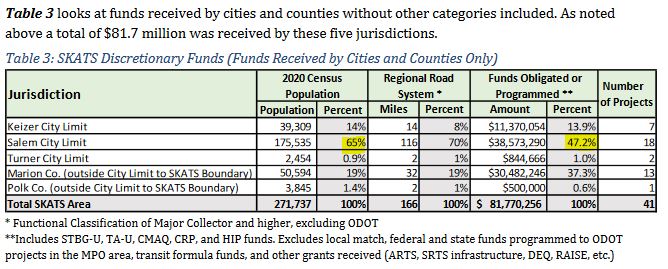
In the meeting packet are some interesting tables breaking down the proportions in allocating dollars to each jurisdiction over a period of about two decades.

Disproportion with Cherriots and regional projects

Probably the more relevant table excludes Cherriots and region-wide projects. The City of Salem has 65% of the population, but received only 47% of funding. Meanwhile, Marion County with 19% of the population grabbed 37%. Those are meaningful differences.

Disproportion w/o Cherriots and ODOT

In addition to questions about the size and proportion of the pie slice, there have been questions about a more general shaping of priorities and chilling of discourse.

We might have initiated climate assessment and planning earlier had the representative from Marion County not threatened to walk out or be difficult. In a polite way, he made his disapproval apparent and so he shaped agenda. Smile and carry a big stick.

As the Policy Committee continues to discusses governance and voting, Aumsville sent a letter asking for the status quo. (Though they cite poverty rates in Aumsville, what do you want to bet they don't vote for or enact policy to reduce poverty? This is likely special pleading and selective detail.)

Aumsville's complaint about "equity"

Though there is no information with the meeting materials, there is a brief mention of a City of Salem application for a grant on Front Street.

A project on Front Street?

This may very well be the planning study associated with the Cannery proposal. Or perhaps that study has wrapped non-publicly, and this is now a grant for design and construction.

In the minutes to last meeting are a number of interesting items.

Monday, November 27, 2023

What is Equitable and Proportional Representation? At the MPO

The Policy Committee for our Metropolitan Planning Organization meets on Tuesday the 28th, and the main thing on the agenda is thinking about representation. You'll recall over the years that non-urban interests are overweighted in the governance structure. This seemed particularly to be a problem in trying to get the MPO to consider greenhouse gas emissions when evaluating projects for funding. Non-urban interests had easy veto power.

The problem is gaining visibility, and in the November packet is a letter from Friends of Marion County, calling for more "equitable and proportional representation."

Letter from Friends of Marion County

They note

a single city council ward within the City of Salem boasts a population exceeding the combined populations of Turner...unincorporated Marion and Polk County...and the City of Aumsville combined.

In the current governance and voting structure, Salem is outvoted one to four, with Turner, Aumsville, Marion, and Polk County each have an equal vote to Salem. Moreover the requirement for unanimity on some votes give each an explicit veto, and the current culture of consensus gives an informal veto as well on other matters that don't require unanimity. 

Just an intuitive notion of fairness suggests the voting structure needs to be reconsidered, and there is also legal language calling for "equitable and proportional representation" on the MPO. Apparently interpretation of this is not settled, however, and there is formal rulemaking process underway with the Federal Highway Administration, which will yield more clarity in guidance. We'll see how they resolve it.

Previously on the problem of representation see:

Cherriots Director Sadie Carney has been particularly good on asking questions at the MPO, and here's another from last month about the way the MPO values and ostensibly "balances" congestion relief and safety.

Monday, November 13, 2023

High Crash Corridors: At the MPO

The technical committee for our Metropolitan Planning Organization meets on Tuesday the 14th, and in their agenda is finally some published information on the Safety Plan project. It has not had agendas or meeting packets published in any formal Public Notice process, and so it has been operating largely in stealth mode.

Here is a proposed list of twenty "high injury crash corridors."

High crash corridors

These track closely to any intuitive sense of zoomy, busy streets that are uncomfortable for walking and biking.

One way the table might be improved is to focus less on "daily traffic," as if the primary problem was simply count of cars and drivers, and to replace that column with a measure of speed and perhaps add a measure of lane width. These vary of course over a corridor segment of a mile or two, but we should highlight that a street with 20,000 daily car trips averaging 20mph is less lethal than a stroad with 20,000 daily trips at an average of 40mph. The count of cars by itself is not a very helpful measure.

At number six on the list is Silverton Road from the intersection with Portland Road to west of I-5.

Silverton Road bond project

As it happens, this segment will be one of the first rehabilitation projects funded by the Salem infrastructure bond. Council recently saw the sidewalk projects rolled up into the larger road project.

Over at our Strong Towns group recently there has been discussions of 4/3 safety conversions and of more narrow lane widths.

Thursday, October 19, 2023

Cordon Road Study Thumbs Nose at Climate: At the MPO

The Policy Committee for our local Metropolitan Planning Organization meets on Tuesday the 24th, and in the minutes to last month's meeting are finally some details on the plan for Cordon Road. The Cordon Road website is not being updated, and the draft plan not yet published for public comment. It's a little weird.

Here's a map keyed to minutes from the last meeting. (The map here is a composite from materials published separately.)

South of Silverton Road widened

South of Silverton Road the study recommends full widening to four lanes.

A "hybrid" design is preferred

The recommendation for widening to four travel lanes just utterly ignores our need to reduce driving traffic in Salem.

First level Climate Goals: A 10% reduction

That the study was going to ignore climate was strongly implied from the start:

They also sprinkle in several roundabouts.