Friday, June 30, 2017

A Century Before the Arta-Potty, a Comfort Station at the Court House

A few years back over at the Woolen Mill's blog there was some talk about the mystery of subterranean public restrooms at the corner of State and High. It was not clear how long they were there and when they were built.

It turns out, they're from almost exactly a century ago! They were bid out and constructed in the summer and then fall of 1917.

Public Restrooms on State and High:
the "kiosk" and iron railings around the stairs are clearly visible
Memorial Day parade, 1941 (Salem Library Historic Photos)
And they were apparently designed by George Post, who also was responsible for many of Salem's now-historic buildings, including our Carnegie Library, one of the Whitlock's buildings, McKinley School, and the McGilchrist building (more here and here.)

June 28th, 1917
From the paper on June 28th, 1917:
Plans have been completed for the comfort station to be erected jointly by the city and county on the southwest corner of the court house lawn, and in a recent interview, George M. Post, the architect, gave the salient features of the building. The station will be entirely underground, with only the stair way railings and the Kiosk visible.

There will be two rest rooms, one for the women, 14 by 18 feet in size, and one for the men 9 by 13 feet. The women's side of the station will be on High street, and the [...] room with the lavitory will extend 51 feet north and south. The State street side, where the men's waiting room and lavitory are situated, is 43 feet long. A drinking fountain will be a feature of each rest room.

Entrance will be gained by means of two stairways, one on High and the other on State street. These will have an iron railing around, to prevent accidents. Tho entire structure will be of re-inforced concrete. Sidewalk lights will help to dispell the gloom on sunny days, and a system of electric lighting will assist at all times. The plumbing will be of a sanitary type.

The heating and ventilating features are especially unique, as the rooms will be heated by a system of gas radiators. Hot water will be supplied by a Rudd automatic gas water heater. The clear height of the rooms will be 8 1-2 feet. The ventilating feature will perhaps be the most interesting feature of the building, including as it does the kiosk, an octagonal shaft 15 feet in height, of re-enforced concrete, rising on the very corner of the lawn. This shaft is hollow, and the foul air is forced up this, and out at the top. Fresh air enters through openings on the stairways, and after passing through the rest rooms is drawn into tho lavitories by an electric fan situated at the base of the kiosk. From the lavitories it passes through air ducts into a utility passage where it comes into the fan duct and is thrown out.

The Kiosk will be an ornament of very artistic design, and will be finished in white cement. Four lamps, of the bracket design will quarter the shaft near the top. The building will be equipped with all modern conveniences and comforts
There was some wrangling at Council and the County over design, funding, and on-going maintenance, but in December they were finally finished.

Wednesday, June 28, 2017

Tell the Federal Highway Administration the SRC is more "de Maximus" than de Minimis

If you weren't scanning the obituaries in the paper or electronic facsimile today, you might not know about a new "comment opportunity" on the Salem River Crossing.
Based on an evaluation of Project impacts, the Federal Highway Administration is proposing Section 4(f) de minimis findings for the impacts described in this notice at Wallace Marine Park, Wallace Natural Area, and the Willamette River Water Trail. ODOT, on behalf of FHWA, is seeking comment on these proposed Section 4(f) de minimis findings.

This notice is seeking comments explicitly related to the proposed Section 4(f) de minimis findings described herein, not to issues related to any other aspects of the Salem River Crossing Project. Comments on the Project itself can be provided following the publication of the Final Environmental Impact Statement (FEIS). FHWA expects to publish the FEIS for the Salem River Crossing Project near the end of 2017. The Record of Decision will address all comments received within 30 days of the publication of the FEIS. Comments received before July 12, 2017 in response to this notice that are not relevant to the Section 4(f) de minimis findings presented in this notice will not be considered as part of FHWA's Section 4(f) decision-making process.

FHWA will consider all Section 4(f) related comments on the proposed Section 4(f) de minimis findings prior to making a Section 4(f) decision for each of these three resources. Please provide written comments regarding the proposed Section 4(f) de minimis findings for Wallace Marine Park, Wallace Natural Area, and the Willamette River Water Trail no later than July 12, 2017 by contacting Anna Henson, ODOT Region Environmental Project Manager, via US post mail or email at: 100 Antelope Road, White City, Oregon 97503 OR Anna.Henson@odot.state.or.us. Please contact Anna Henson at 541.774.6376 if you have any questions.

State Street Advisory Committee to look at Road Design and Land Use Memos

The State Street Corridor Study is back! This afternoon the 28th, the Advisory Committee meets to review a couple of memos, one evaluating three road designs and another evaluating zoning, land use, and redevelopment.

Alternative 2, Road Diet overview
You may remember concern that the project team is using the soon-to-be obsolete analytical framework of hydraulic autoism in their analysis. Note all the "flow" language here. From Chapter 3 of the road design memo:

Tuesday, June 27, 2017

City Council, June 26th - Part 2, a Little More on the CIP

Last night The Capital Improvement Plan for 2018-2022 was at Council. It is worthwhile to look at the totality of its transportation projects, but in the face of the gloriously, swelteringly sunny weekend, nothing seemed important enough to rush a post before Council was meeting. Crucially, there was no compelling reason to argue that the current one should be changed.

But there are reasons to think we might want to modify our approach for future ones. So the walk-through and comments here are aimed not so much at this one, but at procedures for the next one.

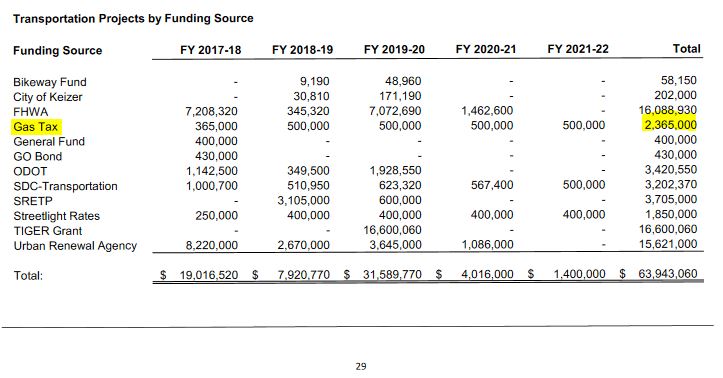
First off, as we argue and debate about the Salem River Crossing and the extent to which Autos First should be our priority, here's a place where the City should communicate more directly about the subsidies for driving. Most of the funding for road projects in the CIP does not come from car user fees, and instead represents transfers from things like home and property value. Locally, we don't fund very much road work at all by means of the gas tax, licensing and registration fees, or other fees directly associated with car use and driving. Other things and other activities instead support road work, and it would be helpful for the City to talk about this more. Drivers don't pay their way and therefore it is especially appropriate to talk about why and how much to subsidize driving.

Lots of property tax related funding here,
URA and SDC funding
A subset of that worth highlighting is the amount of road work funded by new or old development. Previously we had the $100 million road bond funded by property taxes. That's essentially done, and now we are tapping a lot of Urban Renewal Funds and various flavors of System Development Charges, including those at Salem Renewable Energy and Technology Center. (SRETP on the chart.)

The gas tax contribution is very small
About specific projects maybe there are only things to say on two of them.

The TIGER program is still included as the primary source of funding for the big McGilchrist Street rebuild, and this seems doubtful still. It remains a wish and very hypothetical source of funding, especially as the current administration does not seem much inclined to support TIGER and its aims.

The $200,000 for two-way conversation of State Street downtown seems impossibly small, and its project description far too brief.

How are Projects Distributed?

Instead let's take a look at the way the totality of the projects break down.  Here's a chart compiled off of the CIP project list.

Saturday, June 24, 2017

City Council, June 26th - Part 1, Bike Share

Back in December, Council approved a $749,000 Opportunity Grant for the Park Front Building, a project that was already in progress, had tenants lined up, and did not necessarily need the funding.

Capitol City Cycleshare using the Bend system
On Monday, Council will consider a $3,000 grant, about 0.5% of the Park Front subsidy, for six bike share stations in downtown.

Capitol City Cycleshare* says they have raised about half of the $80,000 they want right now, and leveraging a bit of City seed money could help finish things. (They are crowd-funding a $10,000 chunk as well.) The grant is intended to cover five years. So the investment then is $600 a year.

This gleaming chunk of sheetmetal cost $25,000+
Another comparison to make is our investment in public art. The first art pedestal with "The Cube" cost at least $25,000. I think it's an inert failure. Two murals are going up this summer. "Waldo Stewards" looks like a win, but "Mirror Maze" looks like a candidate to be a backdrop for more interesting graffiti. In the public art program we are spending much more per installation, and yet we tolerate some risk and some duds. Heck, we're even paying the Willamette Queen $250,000 a year for not contesting the Minto Bridge. By these standards a $3,000 investment in bike share is very paltry. (Should we just call bike share "public art" and fund it that way? It's certainly more interactive!)

Relative to an office building that was already a sure thing, to our new public art program, and to paying off the river boat, bike share is a far more worthy risk! In broad terms, this small investment should be a no-brainer.

Friday, June 23, 2017

Traffic Jam Anger Tempts with Wrong Solution

This week over on Facebook, a commenter linked to a recent Transportation Research Board meta-analysis, "Closing the Induced Vehicle Travel Gap Between Research and Practice."
Several studies have rigorously documented the induced travel effect, in which added highway capacity leads to added vehicle travel. Despite the evidence, transportation planning practice does not fully account for this phenomenon, with the result that estimates of the potential congestion-reducing benefits of added highway capacity may be overstated and estimates of potential environmental impacts understated. [italics added]
Here we are. "Despite the evidence..."

The bibliography, that list of evidence, is not slender:
Duranton, G., and M. Turner. The Fundamental Law of Road Congestion: Evidence from US Cities. American Economic Review, Vol. 101, No. 6, 2011, pp. 2616–2652. http://dx.doi.org/10.1257/aer.101.6.2616.

Litman, T. Generated Traffic and Induced Travel: Implications for Transport Planning. ITE Journal, Vol. 71, No. 4, 2001, pp. 38–47.

Cervero, R. Road Expansion, Urban Growth, and Induced Travel: A Path Analysis. Journal of the American Planning Association, Vol. 69, No. 2, 2003, pp. 145–163. http://dx.doi.org/10.1080/01944360308976303.

Keenan, K. M. Highway to the Danger Zone: Utahns for Better Transportation v. United States Department of Transportation and Problems Associated with Highway Expansion. Villanova Environmental Law Journal, Vol. 16, No. 1, 2005, pp. 61–87.

Handy, S., and M. G. Boarnet. Impact of Highway Capacity and Induced Travel on Passenger Vehicle Use and Greenhouse Gas Emissions. Policy Brief. Air Resources Board, California Environmental Protection Agency, Sacramento, 2014.

Schiffer, R. G., M. W. Steinvorth, and R. T. Milam. Comparative Evaluations on the Elasticity of Travel Demand. Presented at 84th Annual Meeting of the Transportation Research Board, Washington, D.C., 2005.

Cervero, R. Are Induced-Travel Studies Inducing Bad Investments? Access, Transportation Research at the University of California. No. 22, Spring 2003, pp. 22–27. http://www.accessmagazine.org/wp-content/uploads/sites/7/2015/06/access22.pdf.

Noland, R. B., and L. L. Lem. A Review of the Evidence for Induced Travel and Changes in Transportation and Environmental Policy in the US and the UK. Transportation Research Part D: Transport and Environment, Vol. 7, No. 1, 2002, pp. 1–26. http://dx.doi.org/10.1016/S1361-9209(01)00009-8.

Naess, P. A., M. S. Nicolaisen, and A. Strand. Traffic Forecasts Ignoring Induced Demand: A Shaky Foundation for Cost-Benefit Analysis. European Journal of Transport and Infrastructure Research, Vol. 12, No. 3, 2012, pp. 291–309.

Hansen, M., and Y. Huang. Road Supply and Traffic in California Urban Areas. Transportation Research Part A: Policy and Practice, Vol. 31, No. 3, 1997, pp. 205–218. http://dx.doi.org/10.1016/S0965-8564(96)00019-5.
You may remember this post from 2011 about one of the principal works, maybe the principal work, the one at the very top of the bibliography.

The American Economic Review publishes peer-reviewed papers and is one of the most highly regarded economics journals. It's no publisher of hippie bike kumbaya. It comes at the question from a professional discipline other than traffic engineering and planning. It's a purveyor of cool dollars-and-cents analysis.

Two University of Toronto economists found evidence for induced demand (an effect that had sometimes seemed more anecdotal - or skeptics insisted it was anecdotal as a way to dismiss the effect - than statistically verified) and that we had plenty of roads. As economists, if they thought that road expansion was economically useful, they would say so!

Thursday, June 22, 2017

Equivocating on the word Implement: Our Double-Standard

One of the things that has been striking about national politics is how important norms and institutional culture have proven to be in the interpretation of what otherwise had seemed to be unambiguous traditions and laws, even with regard to the Constitution.

Here, it has been striking how our norms in favor of autoism allow us routinely to ignore what otherwise would be the plain meaning of policy to curb that autoism.

A few nights ago N3B and others reported that the West Salem Neighborhood Association voted 302 to 49 to support a new resolution in favor of the Salem River Crossing.

This should not be surprising. For even if tolls are unpopular, tolling is a second-order assessment of the Third Bridge, and the first order assessment "golly, I hate being stuck in traffic and we really need a new bridge" is widely popular. Hydraulic autoism is not merely the engineering and planning paradigm, it is popular culture and norm. Even the City of Portland, with its bike culture, Trimet, and Climate Change Plan, is behind the Legislature's highway expansion projects.

Current norms enable flouting these
In that context, norms and even statutory interpretation flouting the plain English meaning of policies like "decrease reliance on the SOV" (single-occupant vehicle) and "implementation of transportation system and demand management measures, enhanced transit service, and provision for bicycle and pedestrian facilities shall be pursued as a first choice for accommodating travel demand and relieving congestion" have been banal and customary for a long time. We wink and nod at them, but make sure our actions are only token gestures, enough to give a legal fig leaf for compliance and give the illusion of actually doing something. Our efforts are at best piece-meal, and never systemic. Other mobility is dismissed as "not realistic."

Our prevailing interpretation is as if we wanted to "decrease reliance on eating meat" and primarily sought to accomplish this by adding extra parsley to decorate our plate of prime rib. Parsley! Green! We treat other mobility like garnishes on the main dish of autoism. We are not interested in doing the actual recipe development and cooking for tasty and satisfying meals that don't involve meat or have meat at the center, meals that would be appetizing to people who don't already identify as "vegetarian." (Marinated tofu only gets you so far.)