Showing posts with label City Strategic Plan. Show all posts

Saturday, February 11, 2023

City Council, February 13th - Policy Agenda

Council meets on Monday and the proposed Policy Agenda for 2023 continues to bury climate action.

"Support briefings" - passivity on Climate

It hides climate as a minor subpoint rather than elevating it as a governing high-level value with specific, actionable goals nested under that. One of the six high-level strategies is "Responding to our Sheltering Crisis," and surely "Responding to our Climate Crisis" is at least as important, even if a much longer-range goal.

The TSP and "lower traffic speeds" are nice to see, though.

Still, conceptually, the plan may need revision.

Sheltering Crisis and Our Future

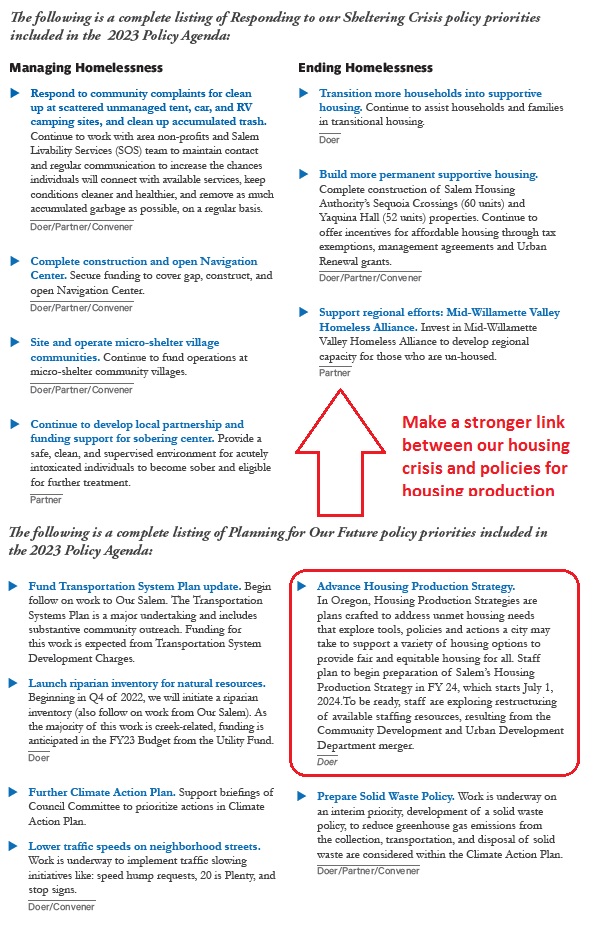
Under "Responding to our Sheltering Crisis," the Policy Agenda really focuses on the management and herding of disorderly people. The underlying problem, however, is lack of housing. Mental illness or addiction, or other problems, may exacerbate the crisis, but the fundamental problem is not enough housing and too costly housing. We don't just need more "supportive housing." We need housing of all kinds.

Thursday, January 12, 2023

City Council, January 17th - Work Session on Housing Crisis and Policy Agenda

You may recall back in 2017 when a driver crashed into a house and killed Srabonti Haque.

And again a year ago when a driver crashed into a house and killed George Heitz and Moira Hughes.

The house was no protection, in 2017 via Twitter

A year ago

A stick-built house with a mortgage and landscaping was no guarantee of safety.

Not even fire stations are safe.

2014 crash into Fire Station 11 on Orchard Heights

On Tuesday the 17th, after the Holiday, Council will hold a formal Work Session on City policies on homelessness and on the 2023 Council Policy Agenda and Strategic Plan.

Tuesday, January 10, 2023

Five-year Forecast, Community Portal and Scorecard, Vision Zero: Bits from Council and the Budget

The airport discussion and vote last night was very disappointing. Maybe there will be more to say about that later. Council seemed more interested in Carbon indulgences than in actually reducing Carbon emissions.

The Budget Committee meets tomorrow the 11th, and they'll see the annual version of the "structural imbalance" chart.

Why are we going to spend millions on the airport?

The chart is familiar. Here's the same forecast from May 2017, five years ago.

Back in 2017

The forecasting keeps saying there will be a big problem, but that big problem does not seem to arrive. Do we really have a problem, or does Staff use a rhetoric of alarmism to shape the budget agenda in certain ways?

I would like to see a more historically informed discussion of, say, the last two decades of forecasts and actuals.

The forecasting looks authoritative, but that may just be on the surface.

Friday, November 18, 2022

City Council, November 21st - Work Session on Strategic Plan and Policy

Council meets on Monday for a formal Work Session on the Strategic Plan, review of 2022 Policy, and starting to set the Policy for 2023.

Is transparency really a priority?

The first thing that comes to mind is the disconnect on transparency and secrecy. There are more than a few disconnects, in fact. There is too much on mood and appearance, and not enough on measurable policy outcomes.

Open data or Salem city secrecy?

One of the policy goals is to "Share performance measures and metrics."

What happened to the ones from Our Salem, eh?

Part of a Report Card concept in 2019

Tuesday, July 26, 2022

City Council, July 28th - Airport Mania

Council meets for a formal Work Session with two topics on Thursday the 28th.

Eugene welcomed a new airline in August 2021
via FB, Keeling curve added

One of the topics will be Salem's hope for something like this, welcoming a commercial carrier and service with great fanfare to the Salem Airport.

The Staff Report talks about considerable cost for necessary remodeling.

To cost millions of dollars

But it doesn't discuss at all the cost in increased greenhouse gas emissions.

The refusal to evaluate policy like this in terms of climate impacts is just thumbing our nose at the Climate Action Plan, ensuring it is symbolic only and never substantial.

Editorial and inset article from June, 2018

The other topic is an update on the Policy Agenda. Two items are of interest here.

Friday, March 11, 2022

City Council, March 14th - Easier Speed Humps

Perhaps spurred on by Councilor Stapleton's recent motions for "Twenty is Plenty" and intersection murals, on Monday Councilor Gonzalez proposes to make speed hump installations easier for neighbors who have noticed speeding problems on neighborhood streets.

It is just so great to see the gathering momentum - or momentum for slowing - for safer streets right now!

Installation on Evergreen Ave NE, October 2012

From the Staff Report:

The City’s current criteria for speed humps is:

  1. The street must be a residential street,
  2. There must be more than 600 vehicles per day, and
  3. Over one half of the vehicles must be traveling over 25 mph.

The separate process would be in addition to, and not a replacement of the City’s current process. The alternative process would:

  1. Be for local, residential streets only,
  2. Not require a minimum number of vehicles per day,
  3. Require only 25 percent of vehicles to be traveling over the posted speed limit,
  4. Require the request come through the respective neighborhood association,
  5. Require the City to consider equity in the request and timeline for completion, and
  6. Require for recycled rubber speed humps to be available as an option. If that option is not yet available, city staff are directed to takes necessary steps to make it available.

It will be interesting to see how this proceeds. Public Works has been reluctant to approve and install them, and yet we continue to see so much speeding. Maybe we can make a paradigm shift finally where we see roads designed for the speed we want rather than norms for speeding leading to higher design speed and to forgiving design on roads. We currently have things backwards.

Friday, November 12, 2021

City Council, November 15th - Policy Agenda and Priorities Work Session

Monday Council meets for a formal Work Session on "Progress report on 2021 City Council Policy Agenda and major Citywide initiatives."

The progress report may be losing its way, however.

We can take a smaller detail as an example. Far into the report it talks about updating the walking and biking chapters of the Transportation System Plan. But it is silent on whether we are actually improving bike and pedestrian safety and inducing greater numbers of walking and biking trips.

An update could be good

The annual report needs metrics. What are we measuring, and are we actually improving on the outcome any policy is designed to affect?

We are failing badly on walking and biking
(Our Salem, June 2019 - not in this report)

Why aren't these indicators from a couple of years ago included in the annual report? We lost them in Our Salem, and we've lost them in other applications where they would in fact be useful.

The annual report isn't reporting on progress very much if we aren't discussing the relevant details. Across most areas in the report it is greatly hampered by the lack of metrics. It prefers to focus on process and procedure. Since it doesn't measure anything, it is free to make unsupported claims and to act as if procedural improvements in fact yield the desired outcomes out in the real world.

Friday, September 24, 2021

City Council, September 27th - Satisfaction Survey and Thoughts about a New Bond

Council convenes on Monday, and first up is a formal Work Session on the annual satisfaction survey and cueing up planning for a big infrastructure bond.

We have choose one of these frames
(front pages, June 2015 and June 2019)

And more than the conversation around the planning process for any Climate Action Plan, what is and is not in any big bond measure will disclose where we are in reality on climate.

Are we going to fund strong climate action?

Or are we going to fund business-as-usual and pay lip service to climate action?

As a "top concern" roads are declining

Yet rush hour remains the focus of anxiety

A great structural flaw in the annual survey is that it floats along the surface and does not make any attempt to tease apart attitudes.

Saturday, January 16, 2021

City Council, January 19th - Strategic Plan

Council convenes on Tuesday with the holiday for a formal Work Session on the Strategic Plan and its activities for 2021.

Six main areas for action

It remains hard to comment on the plan process in any detail at this moment. The Pandemic's exigencies just swamp everything still. And if there had been any uncertainty, now the threat from fascism and white supremacy must be clear. In fundamental ways Council has to be reactive and less strategic, and what is there really to comment on in that?

Transportation and climate

In areas of particular interest here, transportation and climate, the concepts for "year one" are not very detailed. The Climate Action Plan and by Our Salem will drive them, and as a separate process the Strategic Plan can just follow and execute on those other two big processes and plans.

Maybe you will have other thoughts and want to advocate for some particular thing, but it has seemed here that emphasizing Our Salem and the Climate Action Plan was much more important than drilling into this Strategic Plan and advocating for some new initiatives.

Sunday, November 15, 2020

City Council, November 16th - Strategic Planning Worksession

Council convenes on Monday for a Work Session on updating the Strategic Plan. Because of the Pandemic and the crises it causes or exacerbates, it remains difficult to have ambitions much beyond simply responding to the exigencies of the moment.

Council has a hard way to chart.

January 15th, 1919

The Climate Action Plan is in progress as is Our Salem, the update to the Comprehensive Plan, and once they are completed, if the process works right, they will drive much of the strategic planning, not ad hoc sessions like this. In a year or two we should have an even stronger set of high-level values and goals to set Council's agenda and that's something to look forward to.

In the meantime, here are three notes on the materials presented to Council in October. This Work Session is a prelude to another one in January.

In the Safe Community section, the City highlights safety for people walking and biking, and also the new Police Station. Visually and rhetorically, you might think they are roughly the same magnitude of accomplishment. But of course they are not.

Friday, October 9, 2020

City Council, October 12th - Managing to a Goal on Climate

At Council on Monday Counselor Andersen offers an excellent resolution with an important adjustment on the current approach to our Climate Action Plan

He says

I move that the City Council adopt the following goals as part of the City’s Climate Action Plan (CAP):
• By 2035, Salem’s greenhouse gas emissions shall be reduced to 50% of the citywide greenhouse gas emissions for the baseline year of 2016, and
• By 2050, Salem should be carbon neutral.

Our Salem models only an 18% reduction
for 2035, and we need something closer to 50%
Global Warming Commission and Our Salem
(Notes in green added, graphic swapped out)

Though the chart from Our Salem (bottom half of image) lacks time labels, they model conditions in 2035. (Why the project team didn't label every chart is a mystery; this is not good information design.)

The "preferred scenario" out in draft form right now appears to offer about an 18% reduction from current conditions. The difference between "current trends" for 2035 and that preferred scenario is negligible, well within any rounding error or margin of error.

Any scenario worth preferring would have greater reductions, and adopting a set of carbon reduction targets helps greatly with planning for that and achieving it.

In every way we need better metrics, and Councilor Andersen's resolution is a meaningful start on that.

At the same time, the climate goals our neighboring cities do not very often have teeth in them. One way that Salem could make our plan superior to have a clear plan, a flow chart even, for what happens when we miss intermediate targets. Do we have escalating actions that will kick in when we miss on early rounds of measurement?

This is a great step and Councilor Andersen deserves enthusiastic support. (And if at the end of the process we want to refine those numbers, we can always do that, but without a goal to structure our beginnings, we're just flapping and posturing. We do not at this point have to determine that Councilor Andersen's proposed numbers are the right and final ones for us. We just need a target for our start.)

The Pandemic really dominates everything

There's a report on the Strategic Plan, the "2020 Annual Community Report," but it does not seem right this year to dwell on it. Under "Safe Community" they rightly devoted a large section to the Pandemic. Maybe when we see how next year shapes up, it will be appropriate to take a closer retrospective look at this.

Friday, February 14, 2020

City Council, February 18th - Climate Action Plan - updated

The first half of this month has already brought news about record warmth in Antarctica with temperatures in the mid- and even upper-60s.

"climate change is related
to the growing extinction risk"
(February 8th)
The drip-drip-drip of other signs and alarms continues unabated.

Pinot in Peril:
Our Pinot Noir vineyards are at risk
They will likely be grafted over
to warmer climate grapes
(January 28th)
Council meets on Tuesday because of the holiday, and they'll conduct the Work Session on Council goals and policy originally scheduled for January that was postponed to address street camping and homelessness.

Saturday, January 18, 2020

City Council, January 21st - Council Goals and Strategic Plan, part 2

In addition to a Climate Plan, there are several other items of interest at the Council Work Session on Tuesday. I started with the Climate Plan, and wish it were more emphatic and stronger, because I think it would provide framework for so many of the other issues. When we center climate in our policy analyses and debates, other matters and actions snap into sharper focus.

"slower driving" should be included here
It's also mostly about walking - sidewalks and crosswalks
Take the goal to "increase safety for cyclists and walkers to include missing connections for safe routes through the City."

(By the way, it's nice to see "walkers" instead of "pedestrians"! We could go further and say "increase safety for people walking and biking," so that the emphasis is on all people, who will throughout the day and throughout their lives use a variety of transportation activities, and not be limited to one only as some emblem of self-ID or affiliation.)

Just in 2019 and now the start of 2020, the traffic deaths involving people walking have nearly all been in marked crosswalks. The crosswalks have been no guarantee for safety. The death of two people biking and skating are less clearcut, but one involved excessive driver speed, and the other remains a little ambiguous, since the person biking is not able to tell their own story, and police were quick to take the driver's story.)
The Safer Crossings program is important, but it is small and, moreover, the bigger problem is with drivers. Even when we provide better crosswalks, drivers still make catastrophic errors and kill people. Conversely, when people walking or biking make errors, they get killed. We do not adequately account for the asymmetry, that it is always the person on foot who is more vulnerable and who pays the ultimate price.

Fuel subsidy is but one of the ways we subsidize
our autoism - via twitter
And an important element in improving aggregate urban safety is driving less and driving slower. A real Climate Plan will focus on driving less, and safety for people on foot and on bike fits easily under the master narrative of this Climate Plan.

Friday, January 17, 2020

City Council, January 21st - Council Goals and Strategic Plan: Slow-walking on Climate

Council meets on Tuesday (because of the holiday) for a Work Session on Council Goals and the Strategic Plan.

Dissent today at the 9th Circuit Court
(Judge Josephine L. Staton)
Is scoping first a dodge?
The Staff Report on a Climate Action plan is thin. It doesn't actually mention "reduce greenhouse gas emissions."

Instead, it mentions only "practices, programs, and plans...aimed at mitigating the effects of climate change."

It also calls for scoping before actually embarking on a plan.

This is at least a little bit of a slow-walk. Maybe scoping is truly necessary, but altogether it reads like the City wants to do the minimum, to create as little disruption or change as possible, a bit of a Potemkin plan with more signalling than substance.

By contrast, the language recently announced from Barcelona is much more urgent. From Reuters:
The city of Barcelona has declared a “climate emergency”, setting a new target to cut its greenhouse gas emissions by 50% by 2030 through more than 100 main measures that will also help residents adapt to the impacts of a warming planet.
(Over the weekend there will be a little more to say on other items at the Work Session. Updated with link.)

Friday, October 11, 2019

Community Survey Shows Increasing Concern with Housing, Disconnects on Walking and Biking

The latest community satisfaction survey is out, published on the council agenda, and homelessness continues to be the top concern. The numbers on many other issues fall within the margin of error, and several could even round to zero. On walking and biking the survey does not seem to be constructed in a way to generate meaningful results that are actually useful.

Most of the results are within the margin of error;
the only significant change is to homelessness

The margin of error = +/- 4.6%
The fact that people who may not walk or bike are nonetheless asked how they feel about walking and biking renders at least some of the satisfaction levels rather suspect. Probably there are lots of people who don't walk or bike and feel that the City meets the need. "Look at all the bike lanes!"  they might say. So the conclusion here on "room for improvement" is nearly certain to underestimate things badly. If we have a bike commute rate that is less than 1%, it's hard to believe 56% are satisfied with safety and 61% think it easy for people biking in Salem. There's a disconnect between what people say and what they do, and these results just don't add up.

Tuesday, January 22, 2019

City Council, January 23rd - Council Policy Agenda

Council meets on Wednesday for a Work Session on goals and policy.

There's a ton of material, and at a glance it looks like rather than letting values drive decisions, the Staff Reports are designed to have too much detail and to slow-walk decisions. There's something weird about all the stuff and clutter. It's like "are you sure you want to do this?"

Maybe this misunderstand things. At the very least, it's a reminder of the vast amount of material we ask Councilors to understand, and a reminder of the time it requires for that understanding.  To exercise real oversight and not merely to "rubber-stamp" staff recommendations is a lot of work.

We're just going to look at a few transportation things here.

One of the reports is on the 17 recommended actions arising out of the Congestion Relief Task Force.

Do we really need a UGB amendment
for a right-sized Marine Drive?
Though they are "not in priority order," at the head of the list is Marine Drive. And it is interesting that one of the "future steps" on it is an amendment to the Urban Growth Boundary.

You might remember from back in 2016 a discussion of some of the Administrative Rules that would govern Marine Drive:
660-012-0065
Transportation Improvements on Rural Lands
(3) The following transportation improvements are consistent with Goals 3, 4, 11, and 14 subject to the requirements of this rule:
[...]
(g) New access roads and collectors within a built or committed exception area, or in other areas where the function of the road is to reduce local access to or local traffic on a state highway. These roads shall be limited to two travel lanes. Private access and intersections shall be limited to rural needs or to provide adequate emergency access.
(h) Bikeways, footpaths and recreation trails not otherwise allowed as a modification or part of an existing road;
(i) Park and ride lots; [italics added]
A collector-level Marine Drive for local traffic would not necessarily require an amendment to the Urban Growth Boundary.

The TSP currently calls for a "collector" level Marine Drive
(Street System Element of February 2016)
A UGB amendment is necessary if Marine Drive is envisioned as an arterial-sized urban highway.

Monday, December 3, 2018

Our Salem Open House on the 5th - Too much Spitballing?

Our Salem, the process to update the Comprehensive Plan, has an Open House and Workshop on Wednesday the 5th. (A little after, and overlapping, the ODOT Passenger Rail Open House, do note! Consider attending both.)

The public materials, however, aren't exactly clear. They are overwhelming and underexplained!

We are here! (Nov 5th presentation)
According to a timeline presented to the Advisory Committee "we are here": The consultants have reviewed the existing plans, and now, collectively, we are to choose indicators.

But the materials shuttle between values and metrics, and by being unclear about the difference between things we measure and things we value, and unclear about the way metrics are a tool used to help accomplish or retain things we value, we may end up with a muddle.

Sunday, November 18, 2018

City Council, November 19th - Policy Agenda and Priorities

Council meets on Monday for a Work Session on the Policy Agenda. They're scheduled to formulate the 2019 Policy Agenda in January, so this really is just a progress report and time for rumination.

Are the Crosswalk and Transit Committees really
this far in front of the Congestion Task Force?
In the transportation areas of the progress report, staff identify the Crosswalk Committee and Public Transportation Committee as "on target," much further along than the Congestion Relief Task Force, which is merely in "planning." (The four steps, from most done to least, are "completed," "on target," "underway," and "planning.")

Tuesday, October 23, 2018

Council Policy Agenda Town Hall, Planning Commission, Downtown Advisory Board Meet this Week

The City's hosting a Town Hall on Wednesday the 24th to solicit ideas for the 2019 Council Policy Agenda. On Tuesday and Thursday are a couple of other meetings to note.

Council's 2018 Policy Agenda
Our local 350.org chapter strongly suggests that we make a Climate Action Plan - to move beyond the "inventory" in the 2018 Agenda - the center for 2019.
Come to this town hall meeting to tell our City Council that we need to stay on track with a Climate Action Plan for Salem. Salem is one of the only major cities in Oregon without one. Development of a Climate Action Plan needs to be funded in the next City budget for 2019-20.
That would be a fine center. Other goals like Safe Routes to Schools, better bike lanes, improved transit, more housing in the city center all fall easily under the umbrella of a Climate Action Plan and follow naturally from it.

The Town Hall's at Broadway Commons, 1300 Broadway St NE, at 6pm on Wednesday the 24th.

Friday, September 28, 2018

Public Transit and Third Bridge Equally Popular; Biking Satisfation Suspect in City Survey

The City published results from an annual survey this week, and the readings of it seem a little odd, misunderstanding greater precision than the survey actually offered.

In the report the City published, the survey consultant writes
Taken together, 18% are concerned with transportation issues such as roads, potholes, infrastructure, an additional bridge, public transportation, and traffic.
The framing on transportation may serve advertisers most
The paper echoed this:
The survey found residents consider homelessness and poverty to be the top issues they think Salem's elected officials should address (33 percent), followed by transportation issues such as roads, infrastructure, potholes and adding an additional bridge across the Willamette River (18 percent).
Both formulas are misleading, and the SJ's especially so.