Showing posts with label Our Libraries. Show all posts

Sunday, February 11, 2024

City Council, February 12th - Deleting Vacant Positions

Council meets on Monday and the main item of interest here was Councilor Stapleton's proposal for a downtown safety study.

On the rest of it, the lead item for most people was not the safety study but will be the conversation about the City budget. In the near term simply eliminating vacant positions is a reasonable move. But within that there are distinctions to make. One is that the Library is suffering a disproportionate burden.

via FB

Over on FB, Jim Scheppke's on-going series, with installments on Salem's decline from past service levels and under-investment in comparison to Oregon peer cities, has been illuminating.

Councilor Nishioka has an idea about relaxing mural requirements and making provision for time-limited public art to be deployed for less than the current minimum of seven years. This looks like a helpful attempt to simplify some red tape. The discussion in the agenda item remains a little opaque and testifies to our cumbersome regulatory scheme for murals and public art:

Art displayed publicly meets the definition of a “sign,” under the City’s sign code. "Sign” is defined as a thing that is designed, used, or intended to attract the attention of the public. SRC 900.015(f) exempts public art and murals that are owned by the City. For murals, the City obtains an easement agreement for a seven-year period. This motion directs staff to investigate ways to allow for a shorter time period to allow murals and other artworks to be publicly displayed.

There are grant opportunities for temporary art projects. Temporary art projects will increase cultural and community involvement in art projects within our neighborhoods and parks. A thriving arts scene can stimulate economic growth by attracting tourists, supporting local businesses, and creating job opportunities. Community art projects provide opportunities for relaxation, stress relief, and emotional expression, contributing to overall wellness and quality of life.

Hopefully there will be a way for this to move forward. More art should be understood as ephemeral, as existing in time with an end, and we should have a better City legal framework for this and a greater general cultural acceptance of non-permanent art.

Wednesday, April 19, 2023

Library at the Budget Committee; Neighborhood Traffic Plan - Bits

Back in February at a formal Work Session, Council examined a study of staffing and funding levels of city service areas in comparison with the levels of a group of peer cities.

From the February work session

The study of course had a set of aims and a rhetorical shape. It was meant to buttress the case for more City staff and funding. It showed a lot of red for areas of concern with "understaffing" and "under-resourcing."

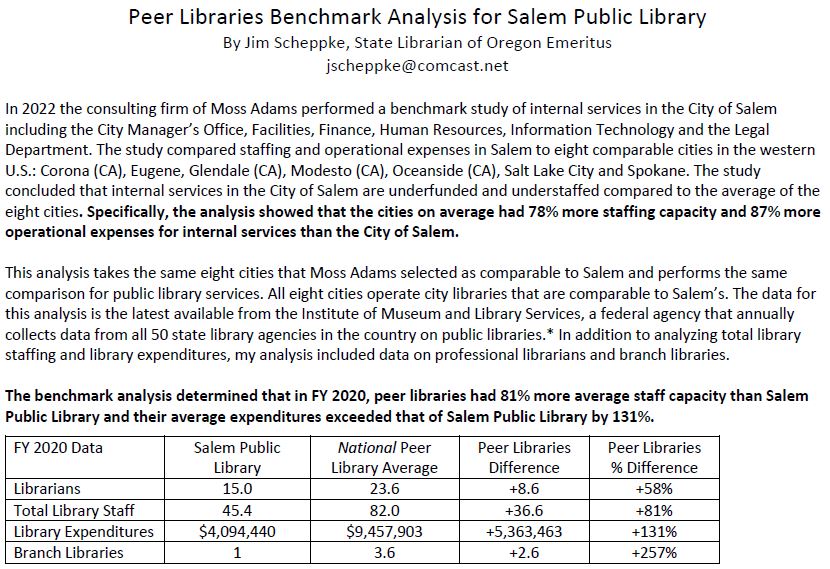
In a neat bit of advocacy judo, retired State Librarian Jim Scheppke took the benchmarking study as a template and applied it to Library staffing and funding in those same peer cities. He presented his findings in comment to the Budget Committee, which meets tonight on Wednesday the 19th.

Public Comment for April 19th

The undernourishment of our Library has been a consistent theme over the years, and this was a useful new angle on that, employing the City's own mode of analysis.

Will Council listen? Or get distracted by the appetites for Police and Fire?

Salem Reporter has more on the agenda, including some extended comment from Councilors, "Committee considers fees, taxes in effort to balance 2024 Salem budget."

Two new plans bundled

More than a little quietly, back in January the City apparently published a draft of the Neighborhood Traffic Management Plans. They split them into a Traffic Calming Plan and a Stop Sign Plan.

Wednesday, June 29, 2022

Notes on City Library Plan and State Library Historic Listing

The City Library is undertaking a process to write a new strategic plan and the steering committee meets today, Wednesday the 29th.

Existing Conditions Situation Assessment

The "Situation Assessment" on existing conditions is interesting. It continues to be weird how much people focus on a lack of free parking as a barrier. Poor people often don't have cars at all, and much of the complaint about free parking is from people who can afford to pay for parking, but find paid parking annoying and project their complaint onto others more disadvantaged to secure legitimacy for the complaint. 

The Library could always offer parking vouchers or passes to people with Oregon Trail Cards or manage any regressive aspect to paid parking in ways other than free parking for everybody.

Fortunately, people have also focused on other problems: Lack of branch libraries, difficulties with transit, and barriers to walking and biking. There are real spatial problems with our Library. Hopefully the process will give more attention to these and less to parking.

Transportation and location themes

It will be interesting to see how the process grapples with the trend to dematerialize the Library. Ebooks and digital resources are important, but the beating heart of the Library remains the physical place and the physical book. However much the metaverse wants a disembodied existence, we live in our bodies.

Sunday, January 16, 2022

City Council Work Sessions - January 18th

Council will hold a double Work Session, moved for the holiday, on Tuesday the 18th to talk about and plan the micro-shelter project and other response to people without adequate housing as well as to finalize the Council Policy Agenda for 2022.

In the Council Policy Agenda, there does not seem to be a lot to say. It might be nice to have climate centered even more, but the agenda is for 2022 only, and "Coordinate and implement strategies in the Climate Action Plan" is one of the items. So is an update to the Transportation System Plan and adoption of Our Salem. Collectively we can center climate in each of these, and at least theoretically there is room by regular city political processes to strengthen climate action in them.

There are several pieces in the response to the housing crisis. Others will have analysis and better thoughts. It seems significant that last week one person who had initially submitted comment in opposition to one site, later in the day submitted revised comment in favor: "I was not under the impression that the shelter would include 24 hour security or on-site staff. Now, having done thorough research, I support the City in allowing a micro-shelter to be placed at 1280 Center St, NE." That is an admirable instance of making the effort to look into things more closely, and changing opinion with new evidence!

An empty space to admire? Or a place for life?
Deadness at the end of a work day (2013)

I want to point to a small moment at a different proposed site. Public comment on the proposal for a managed micro-shelter camp at Peace Plaza unsurprisingly is mixed. Some think it is a great location, near services and transit, and visible to City Hall to help ensure it's not swept under the rug. But some who live on Gaiety Hill in the Historic District highlight exclusionary and NIMBY themes. It is worth dwelling a moment on ways some comments make explicit the implied exclusionary zoning function of Historic Districts. 

(Other objections are the usual: Proprietary claims to on-street parking and martial tropes of "invasion" and "occupation." Garbage. One person suggests they should all be institutionalized at the State Hospital. Etc., etc.)

On Exclusionary Function of Historic Districts and Zoning:

A half-dozen Gaiety Hill neighbors...are unanimously and vehemently opposed to utilizing Peace Plaza as a location for micro shelters or any other housing project. Beyond the dozen reasons previously offered, the diminished property value of our historic homes will result in legal action to reverse any decision the City may make to utilize Peace Plaza for the purpose of micro shelters. We have already consulted a local law firm and are prepared to take action. We will not allow our lifelong investments in this Historic neighborhood to be diminished via this ill-advised folly.

A group of neighbors - including homeowners, CPA firm, Attorney firm and Architectural firm are concerned about the existing zoning of Peace Plaza. Any development for micro shelter would need to pass land-use changes. We have consulted with a local law firm and a local land use specialist and believe this will be a costly - and ultimately fruitless - endeavor. Consideration of this site should be abandoned.

Previously on Peace Plaza, especially its Inertness:

On our Historic Preservation Framework:

And on the History of Salem Zoning:

Wednesday, December 15, 2021

MORE PARKING!!! won't Solve Peace Plaza's Deadness

On Monday Council approved an ask for the Legislature.

Celebrate Salem Civic Center’s 50 years. Prepare Peace Plaza for 50th anniversary - August 18, 2022 - and years to come as an attractive, welcoming community asset. Funding for this work would restore the fountain and add greenspace and accessible parking to Peace Plaza area.

Peace Plaza desolate in the early evening, 2013
(click to enlarge)

The Staff Report was a little vague and Salem Reporter shared more clarity:

Courtney Knox Busch, Salem's strategic initiatives manager, told the legislative committee that project would cost about $1 million.

Parking on West side, from October 2013 concept

Probably the City is thinking about dusting off the concept plan from the early 2010s, when the hope was for a new Police Station at Mirror Pond. These drawings show a new parking area where there had been a gridded lawn with trees. The pavers have been removed already, and it seems like they might already be heading down that path.

Gridded lawn area would become parking

But converting this to parking would be a total waste and drain on the plaza. There are already parking garages south of the Library and north of City Hall. The one on the north side is no longer used by Police and should be available. Parking is not a problem. If parking becomes a problem, paid parking, right-priced so 15% of stalls are always open, solves it.

The problem with Peace Plaza's inertness is inactive edges, not insufficient parking.

Wednesday, October 13, 2021

Art at the Library a Highlight of New Space

It was so great finally to be able to visit the Library again last week.

They improved the side hallway into a gallery

The day was cloudy, and I did not find that the interior light levels quite met the glow promised in the pre-construction architectural renderings. It was still a little dim and gloomy in places. I hope they can adjust the lighting to make it brighter on winter, rainy days. (My pictures shift amber and are much dimmer than the light levels as I experienced them with my eyes in person, however. The art was generally well lit.)

I did not find the space as legible as I hoped, also. I wasn't looking for things, and hoped they would be obvious. I had no idea where the reference section was. Where's the Hugh Morrow collection now? Divisions in the Library's collection were not obvious. I know I will learn where they are, but I had hoped they would be legible and obvious, that the space itself would be easy to read without signage and I would not have to work to understand where things were. But it is a kind of generic white box now. More flexible, probably, but maybe we will need a map or directions at first.

"Call Number Cascade"
Does it really invoke Dewey decimals?
(detail, Councilor Hoy)

The highlight, and wholly unexpected, was the art. The new commission, Call Number Cascade, to see in person was still disappointing. It is busy and too jumbled to read. It totally requires a title and artist statement to decode and parse. Public art in contexts like that should be legible without an artist statement. The statement might add nuance and layer, but it should not be necessary to have a basic sense for the art. Even just formally it's not exciting. The colors are desaturated, and don't really function well as an abstract splash of color. The black looks like ink spots from a leaky fountain pen. I look at that big wall and I want more wonder and delight on on it.

Do you love it?

It will be interesting to read and hear what others have to say about it, whether they find more delight in it and better ways to engage it.

Other art was better lit than it had been in the old space and deployed in thematic groupings. It was a real treat. There were no tags, so aside from a few pieces I recognized, it was easy to approach it with a fresh, open mind. And the way there were obvious rhymes in each cluster meant the art was possible to "read" without a decoder ring. Bold color did a lot of the lifting.

Thursday, September 2, 2021

Library First Impressions: Walking and Biking to It

It has been a little surprising to see people complaining about the new, brighter interior of the Library. Do they remember how dark and gloomy it was? Probably as more art is installed there will be more splashes of color, but the basic white, wood, and gridded ceiling just seem clean rather than sterile. Particularly when there are people in it, the white will be a neutral canvas for the life of books and of human activity.

The nooks look pretty warm and inviting, don't they?

The nooks used to be blocked, and now they are open!

It was of course a great disappointment not to be able go to the Library yesterday. Postponing the opening is the right decision, but a sad one.

Once we all can actually go inside with the regular buzz of activity, there will be more to say, and we may have to revise some of our first impressions made from photos.

But we can talk about the exterior a little! The City's release the day before the postponement was announced, "Parking Update at Renovated Main Library," was completely autoist, and just assumed everybody would visit by car. But people will walk, bike, and bus to it also. And while these were not primary interests for the seismic and renovation work, the team made some changes also for non-auto access and circulation.

Saturday, July 17, 2021

Library Bits: New Photos, Project Reticence, New Art

The other day Councilor Hoy published a bunch of photos from a tour of the Library renovation as it is nearing completion. "[i]t's quite remarkable! This open, bright and welcoming space is a huge upgrade!" he said.

Project has not been Exactly Open

Maybe there will be more when the building finally reopens, but the process, and the Committee overseeing it, hasn't shared as much information as they might have.

It's hard to say what is the right balance. On the architect's project page they say:

With almost no wiggle room in a utilitarian budget, the design team for Salem Public Library needed to get creative finding ways to make every dollar spent do double-duty.

Too much public process and public information might create friction, opportunities to second-guess, critique, or otherwise slow and complicate a project on a small budget and a tight timeline. It is not so difficult to understand why they might want to present it to us as a done deal when it is too late to create public process sludge.

Still, it's weird there's not an easily accessible summary plan. There is a presentation on issues and design solution at a very general level from April 2019, and a much briefer presentation from March 2021, but these don't show the final plan with focus areas called out. The Library Renovation Council Subcommittee just publishes bare-bones meeting agenda at the City's project site. You'd think there would be a greater number of presentations to the committee published as part of a meeting packet. And no overall summary. It's disappointing there is not more information easily accessible.

Further, you may remember the weirdness in the paper when the Statesman-Journal tried to preview the project in May:

Officials with the Portland-based general contractor company Howard S. Wright Construction, a subsidiary of London-based Balfour Beatty, declined to allow media photos unless the photos were reviewed and approved by the contractor before publication.

Because it is against the Statesman Journal’s policy to allow this type of control in the editing process, a Statesman Journal photographer was unable to take photos or videos of the site.

When city officials were questioned about a private company controlling access to a public building in a way that limited the public’s ability to see the taxpayer- funded work, officials deferred to the contractor, who they said has control of the site until construction is completed.

So we are left with little - and very selective - photo albums posted to social media, like what Councilor Hoy has done. It's nice, but it's also a very controlled information release.

Trellising or Seismic or Both?

One element in Councilor Hoy's photos that was interesting is what appeared to be a large wall of vertical trellising for greenery on the Peace Plaza side.

A nearly identical bay is also visible outside the construction site from Commercial Street.

Vertical trellising for greenery? Commercial St. side

The first remodel of the early 1990s had filled in what had been a full length arcade and main entry in the original plan. That remodel had retained the stairwell, though.

Saturday, February 20, 2021

City Council, February 22nd - Our Salem and Weasel Words on Climate

In the aftermath of the ice storm, Council meets on Monday to consider changes to the Comprehensive Plan.

The Staff Report for Our Salem on the Comprehensive Plan is sortof cheery, but it swerves a little from one of the central matters. In the details it makes little progress on our climate goals.

The details remain distant from "carbon neutral"

Here it discusses most recent revisions from the initial September draft, but does not say that the Plan projects to meet our climate goals but only that it "would help Salem move closer" to achieving the goals.

The revisions largely aim to help create more complete neighborhoods. Under the proposed Comprehensive Plan Map, there would be more opportunities for residents to live closer to and more easily access shops, services, and amenities without driving, and the revisions would allow more people to live and work in the same area or on the same property. This would help Salem move closer to its greenhouse gas emissions reductions goals.

Council should ask for more revision and a plan that has a realistic chance of actually meeting the emissions goals, not merely "help Salem move closer." (There are also significant questions about the way the City understands "complete neighborhood," and it is likely they are using a very loose and overbroad interpretation of that, which allows them to make overstated claims for the effectiveness of this draft plan. See link below on that.)

Those are totally weasel words!

Farther down in the Staff Report, in a detail discussion of climate, we see that the "preferred scenario" really doesn't even "help Salem move closer":

Specifically, the daily VMT per capita is projected to be 17.66 if Salem were to continuing growing under current policies (e.g., current trends) versus 17.56 under the revised preferred scenario. The GHG emissions from transportation similarly did not significantly change: 792,000 annual metric tons of CO2e under current trends to 777,000 under the revised preferred scenario.

No significant change is the real analysis! It hardly helps at all.

Sunday, December 27, 2020

Local 350.org Chapter Comments on Our Salem and Climate Action Plan, Centers Driving

Last week the City blurbed all the sustainability features at the new Library.

via FB

In addition to the seismic engineering, they said "We're striving for LEED Silver level for sustainability and energy efficiency." It's all about rooftop solar, insulation, more efficient light fixtures, low VOC building materials, and low-flow water fixtures.

Those are good things. But as is so often the case, we have erased driving from "sustainability." (LEED stops at the building envelope, and does not include how a building functions as part of a city or neighborhood. It's atomic rather than relational.) 

Over at City Observatory, they wrote about this in "Sustainability is about more than electrification," introducing the notion of a "car island," a new subdivision greened-up with all kinds of neat solar installations and associated gadgetry, but utterly car-dependent.

We must look beyond energy use to consider how people move and accomplish life’s daily needs. A car island is not human-scaled or sustainable. For too long, we have focused on building height when thinking about “human-scale” development. Yet, this is the wrong reference point. Human-scale development is about distance, not building height.

If you have to use a 2-ton vehicle [whether internal combustion or battery electric] for every need, it’s not human-scaled and not sustainable. And even EV cars have a ton of embodied energy/emissions.

Previously we have noted this at the new Fairview developments, which have focused on green building, driveways, and garages, but essentially remain dominated by single detached housing and have no walkable commercial redevelopment yet.

And in the digital sticky note "visioning" exercise, a couple of people called for less compact housing, is if it were in fact more sustainable, and confounded a literal reading of "green" and the metaphorical reading of "green."

Instead of turning green spaces into housing, how about keeping them as green spaces and growing more trees. Despite protests from neighbors, a large part of the green space around Oregon State Hospital was turned into a housing lot. We can't keep doing this.

Require more space between homes in new developments and less impervious surfaces.

We have a real blind spot at the moment.

Friday, April 10, 2020

City Announces new Art for the Library Remodel

Hey, here's some pleasant news that's completely unrelated to our current crisis moment.

"Cutouts," "Wall stacks," "Hawthornes" - relevant examples
from Amanda Wojick
In the City Manager's new update is a bit on the art selected for the Library's seismic remodel (unfortunately the Public Art Commission itself has not published any discussion or materials):
The public art selection committee for the Library has selected Amanda Wojick as the artist to move forward with for the Library’s commissioned piece. Amanda is a professor at the University of Oregon and has many public commissioned pieces on her resume. She titled her proposed piece as a “Dewey Decimal Waterfall” and described (sorry, no visual of the concept) it as: “The proposed project will be a large wall relief comprised of tilted, painted and welded steel planes. The composition is inspired by the many beloved waterfalls in the state of Oregon, together with the symbols and shapes found within the Dewey Decimal system. The shapes will be arranged in layers, creating a three-dimensional relief that changes from different perspectives.” [links added]
She's repped by Elizabeth Leach Gallery in Portland.

The cutouts, wall stacks, and hawthornes (see her site and also Elizabeth Leach's) look like relevant examples that point to what a Dewey Decimal waterfall might itself look like.

The cascade of knowledge and information, along with the nod to our winter weather when rains make the library especially welcome, on the surface is an apt set of metaphors. Hopefully the waterfall will be something children can grasp as art and interesting and lovely enough to engage adults also.

WPA poster - via Library of Congress
(many more posters here!)
The commission is also a reminder that with all the museums, symphonies, and other arts organizations shutting down temporarily and some of them permanently, we will need a WPA style arts program at the Federal level.  You may recall the Federal Art Center in the old High School where Macy's is today.

Salem Federal Art Center at the old high school
(From a history of the Walker Art Center in Minneapolis)

Friday, September 20, 2019

Part of Civic Center Design Team, Howard Smith Passes Away


You might not have noticed, but a couple months back The Mill announced that they'd processed a recent donation, drawings and papers from Payne Settecase Smith Architects.

About it they said
The architectural plans in this collection represent the work of a firm who changed the look of Salem and the wider Willamette Valley during the post World War II era, one of the largest building booms in American history...[They] also represent the changes in architecture during the 1950-1970s. Influenced by the modern art movement, architecture during this time diverged significantly from traditional architectural styles. One of the best examples of this in Salem is the Salem Civic Center. Built in the brutalist style, the Payne, Settlecase, and Smith firm pushed the boundaries of acceptable public architecture.
One of the Principals, Howard Smith, died last week.

Godspeed.

Friday, July 5, 2019

City Council, July 8th - Daylighting Pringle Creek

Council meets on Monday and a slate of three tranches of Urban Renewal funding leads the way.

View towards the Minto Bridge from Commercial St Bridge -
with retaining wall and concrete cap
Most interesting here is action on daylighting Pringle Creek and preparing for the path system in the former Boise project.

Also worth notice is increased funding from URA funds for both the Police Station and Division Street at the Police Station.

The Cthulhu keyboard and fish ladder
to be removed
 (Back in 2014)
You may recall a brief note back in April that the City was working on plans to remove the concrete cap over Pringle Creek between Commercial Street and Riverfront Park, in the area of the former Boise Cascade plant. A year before that, in April of 2018, the Nursing Home project was announced as delayed again, and we saw the first public discussion of cap removal.

Tuesday, January 22, 2019

City Council, January 23rd - Council Policy Agenda

Council meets on Wednesday for a Work Session on goals and policy.

There's a ton of material, and at a glance it looks like rather than letting values drive decisions, the Staff Reports are designed to have too much detail and to slow-walk decisions. There's something weird about all the stuff and clutter. It's like "are you sure you want to do this?"

Maybe this misunderstand things. At the very least, it's a reminder of the vast amount of material we ask Councilors to understand, and a reminder of the time it requires for that understanding.  To exercise real oversight and not merely to "rubber-stamp" staff recommendations is a lot of work.

We're just going to look at a few transportation things here.

One of the reports is on the 17 recommended actions arising out of the Congestion Relief Task Force.

Do we really need a UGB amendment
for a right-sized Marine Drive?
Though they are "not in priority order," at the head of the list is Marine Drive. And it is interesting that one of the "future steps" on it is an amendment to the Urban Growth Boundary.

You might remember from back in 2016 a discussion of some of the Administrative Rules that would govern Marine Drive:
660-012-0065
Transportation Improvements on Rural Lands
(3) The following transportation improvements are consistent with Goals 3, 4, 11, and 14 subject to the requirements of this rule:
[...]
(g) New access roads and collectors within a built or committed exception area, or in other areas where the function of the road is to reduce local access to or local traffic on a state highway. These roads shall be limited to two travel lanes. Private access and intersections shall be limited to rural needs or to provide adequate emergency access.
(h) Bikeways, footpaths and recreation trails not otherwise allowed as a modification or part of an existing road;
(i) Park and ride lots; [italics added]
A collector-level Marine Drive for local traffic would not necessarily require an amendment to the Urban Growth Boundary.

The TSP currently calls for a "collector" level Marine Drive
(Street System Element of February 2016)
A UGB amendment is necessary if Marine Drive is envisioned as an arterial-sized urban highway.

Tuesday, January 8, 2019

Library and Traffic Advisory Boards Meet Wednesday - updated

Summary of Annual Report in 1918
January 8th, 1919
Something's awry at the Library. You can read more about it at Save Our Books. They've got rid of the Reference Desk (and some number of Reference Librarians presumably) and been purging books beyond normal weeding practices. Though apologists have defended it as maintenance for a "dynamic collection," it looks rather more like the leading edge of radical change to the whole concept for our library. Is the library for books of enduring value and where you can do research? Or is it mainly for transiently popular best-sellers and where you can chat with your friends? That oversimplifies, and public libraries must do some of both, but each library's balance gets at the matter of focus and purpose. And if it's a change here of any magnitude, more of the community should be involved in the decision.

Wednesday, January 2, 2019

Walnut by old Carnegie Library to be Removed

The tree in early May 2013
CANDO is reporting that the Walnut at the old Carnegie Library on the Winter Street side has been posted for removal this week. It has been in decline for several years, probably from that Thousand Cankers disease carried by the Walnut Twig Beetle.

Streetview from June 2018 shows its decline

The tree much smaller in 1911, detail
(Salem Library Historic Photos)
It was a great tree. By itself and out of context, there are finer trees around town, but together with the Library, it was a great match. It was always so pleasing to walk by it and under it.

Sunday, December 16, 2018

Rumble in the Stacks: Library Weeding Elicits Strong Opinions in the Wild

In the campaign to stop or at least give visibility to the scope of the Library's new weeding policy, our former State Librarian highlighted several egregious or ironic discards. Once the story got picked up in the press, librarian twitter surprisingly had little sympathy. Although outside commentary was missing key local facts, and may have assumed Salem did no weeding previously, it also revealed a more lively internal debate among librarians about the scope and purpose of a collection.

The current effort at the Library had seemed obviously overzealous and that once that saw the light, on it a professional consensus would obviously emerge that it was prudent to throttle it back significantly. We should remember they eliminated the Reference Desk also. How was there going to be any debate? It seemed like a slam-dunk.

But out-of-state, this elicited contempt!
But no! An out-of-state librarian who was probably just reading the headline, and knows nothing of local conditions, but later did read more, yelled back "YOUR PUBLIC LIBRARY IS NOT AN ARCHIVE OR WAREHOUSE FOR BOOKS," and her response seemed to be endorsed by several other librarians, who piled on with surprising scorn. They were not very polite about it, and ridiculed anyone who might say "slow down." This is fascinating! To them, it was equally obvious that we should be throwing out books, left and right; it is only a benighted antiquarianism, or some such stupidity, that argued for restraint and a more careful weeding and retention plan. Surely our stacks are crowded and need thinning! Surely we are clinging to useless things!

This was a surprise to see.

Wednesday, November 21, 2018

As Books are Culled, the Library Deletes the Reference Desk Also

On a visit this past week to the Library, it was a shock to see a faded carpet ring where the Reference Desk used to be.

The "on duty" Reference Librarian turned out to be at the check-out desk, mainly handling that part of the business. They maintained a neutral perspective and affect when asked about the change, and it was not possible to get meaningful information. It seemed likely there was a staffing change involved, either less staff time for Reference activities or a downskilling of Reference positions to be more clerical and therefore less expensive.

The shelves also seemed barer.

Last month an entire run of a periodical I had consulted at the Library before had disappeared, and the Librarians could not find a record of it. They thought I was mistaken to ask for it. This was very strange and unsettling.

So it was very interesting to read the post over at Hinessight, "Salem Public Library removing 30% of print book collection. Resistance is mounting."

Asking the Library mainly for business-style efficiency will lead us to harm our cultural knowledge. From the new head Librarian's response to questions about the book cull:
We also use a product called CollectionHQ, which gives us use metrics, turnover rates, and identifies under- and over-stocked subject areas. With these outlined methods and derived data, we can identify items that no longer circulate, items in poor condition, and outdated information in areas of rapid change such as medicine. We also look for superseded editions, excess copies of previous bestsellers, and worn copies that need to be mended or replaced.
This is an application of Big Data and Taylorism that could easily get out of hand.

Saturday, October 20, 2018

For 2020 Library Should Align Salem Reads with Our Salem

Even if the colors aren't quite magnificent, it's still pretty great
Make sure to get out before the rains start!

Poster in the foyer
At the Library the other day, I noticed the announcement for the 2019 citywide reading club selection.

The City doesn't seem to have updated their website, but Library Foundation has some info. About Good Morning, Midnight the publisher says
Lily Brooks-Dalton’s haunting debut is the unforgettable story of two outsiders—a lonely scientist in the Arctic and an astronaut trying to return to Earth—as they grapple with love, regret, and survival in a world transformed.
One reviewer calls it a "sparse post-apocalyptic novel."

So considering the urgency of climate disruption, that's apposite for sure.

Indeed, the Library Foundation says it
sees Salem Reads as an opportunity to increase the Library’s visibility, and act as a catalyst to bring the community together around shared values. The committee selected Good Morning, Midnight because the book has many dimensions that lend to broad community engagement. These include science education, climate change, species extinction, isolation, living in extreme environments, and disaster preparedness.
For 2020 the City and Library Foundation should consider The Death and Life of Great American Cities or, if that's too old a classic, some more recent book on urbanism and urban analysis. If non-fiction's not the thing, there's probably some novel that's appropriate. Whatever they choose, they should give strong consideration to making "the city" and the history of the city the thematic center for the selection.*

"Our Salem" is an important multi-year project to update the Comprehensive Plan, and it could be helpful to extend the set of concepts, vocabulary, and debate beyond the planning nerds, neighborhood advocates, and business interests, and to give people a broader foundation with "shared values" and terms in common for sharper debate and analysis.

* Heck, one of the main characters in Good Morning, Midnight is named Augustine! His namesake wrote on the City, of course, if also in a little different context. Still, that's a bridge, right there.

Postscript, May 16th, 2019

There never was very much chatter or press about the book and associated events, and I wonder how popular it ended up being.

Can we risk semi-spoilers now? The book seemed to rely on a trick ending and an unreliable narrator. It was a little gimmicky, and not wholly satisfying in that way. It also didn't end up having much to do with climate change, also. As an entree, then, to some urgent cultural and political questions, it may not have been very effective.

The Library's compiled a short-list for the 2020 selection, and it doesn't look to have anything to do with Our Salem or with "the city" as an object for thought and analysis.

Friday, February 24, 2017

City Council, February 27th - Delay at Boise, Library Seismic Deferred

As an expression of our current Zeitgeist, the splitting of a Civic Center bond into multiple pieces looks apt. This Monday Council meets and looks to ratify the decision for a "divide and conquer" approach. They'll put at least two bonds on the ballot separately.
1) Adopt Resolution No. 2017-18 calling for a measure election to be held on May 16, 2017, in the amount of $61.8 million, to finance the development of a new public safety facility

2) Adopt Resolution No. 2017-19 calling for a measure election to be held on November 7, 2017, in the amount of $15.3 million to finance seismic and building safety improvements to the Library
Neglecting
the Library is
an effective symbol
The charitable reading of maximum sincerity is that Council really believes the city will rally behind the Library in November, even in a likely face-off with (or against) a Public Schools bond.

At least from here, the more likely reading is that peeling off the Library work greatly reduces its prospects, and allows the City to bump up the scope and cost of the Police Facility.

At the level of symbol, it is a "Know-Nothing" statement for more Law and Order at the expense of Knowledge. Like it or not, it says something about our priorities.

Bundling and mutually leveraging the needs seemed like the best chance for a right-sized Police Station and for desperately needed seismic work on the Library and City Hall. It also acknowledged trade-offs.

Now we'll likely see a "Yes, but" campaign like Cherriots faced in the fall of 2015: "Oh, we support the Library, but this is the wrong time/cost/tax..."

You might disagree, but it's hard to be hopeful about chances now on seismic work for City Hall and the Library. We will have funded and built years 20-40 of a future Police Station, which will be vacant for the first 20 years, at the expense of a seismic retrofit for the Library and City hall, useful right now. Building extra empty space for future growth to deny other urgent needs is utterly baffling. [Revised for clarity]

Other Things

Past the Library and Police Station, there are several of smaller things of interest.

Delay at Boise

Delayed!
Developers on the Marquis Nursing Home are filing a formal delay on the project.